
Q4 starts today, which means solopreneurs everywhere will soon perform their favorite seasonal ritual: they’ll spend October “getting ready,” remember Black Friday exists around November 17, throw together an offer, publish seven increasingly frantic posts, and expect strangers to complete an entire buying journey before Thursday.
But we can do better than that, you and I.
If you want to make money in Q4, especially at the end, around Black Friday and December, when most small businesses generate around 30% of their annual income.
This number bundles together e-Commerce and retail, so it might be lower for you. Nonetheless, Q4 is a pivotal quarter for any business:
- For product-based solopreneurs, Black Friday can be absolutely huge, precisely because their audience is accustomed to buying products around that date.
- For service-based solopreneurs, it’s usually a mixed bag: on one hand, Q4 is when clients finalize budgets and make year‑end purchasing decisions, so well‑positioned service providers can close larger retainers or “use‑it‑or‑lose‑it” budget projects. On the other hand, December is a slow month, with the holidays and many decision-makers either out of the office or mentally not there.
So let’s talk about what you can do NOW to make Q4 the best quarter of the year yet and start 2027 with a bang.
But before that, here’s one harsh reality: no matter how well-planned your Q4 is, if your messaging is off, people won’t buy. Today’s partner can help you fix that.
📣 Brought to you by 📣
The Message Reality Check
You work hard on your marketing. But if people land on your website and don’t immediately see themselves in your work, they leave without a word.
Dr. Michelle Mazur’s free Message Reality Check analyzes your actual homepage and delivers a personalized written diagnosis showing exactly where your message is losing clients — and what to fix first.
Takes about three minutes.
Run your Message Reality Check!
Want your name up here? Reserve your slot!
Your sales campaign probably starts too late
I told you before that the source of most revenue problems can be tracked 90 days before it shows up in your account. If you start today, odds are late November and December will be great months for you.
A 2025 study from 6sense found that B2B buyers first contacted sellers roughly 61% of the way through their buying journey. They had already researched solutions, developed preferences, and formed a shortlist before the vendor knew they existed.
The study looked at large B2B purchases with a median value between $200,000 and $300,000, so I won’t pretend it gives us the precise buying journey for your $99 workshop.
It does, however, support a broader reality we can observe in smaller businesses too: people often investigate you before they identify themselves as potential buyers.
They read your newsletter. They lurk on your LinkedIn profile. They visit the sales page. They search for evidence. They save the offer. They ask a friend whether you’re as good as you appear or merely excellent at using em dashes.
Then, if enough pieces line up, they contact you.
By the time the sales conversation becomes visible, much of the decision may already have happened.
So start here:
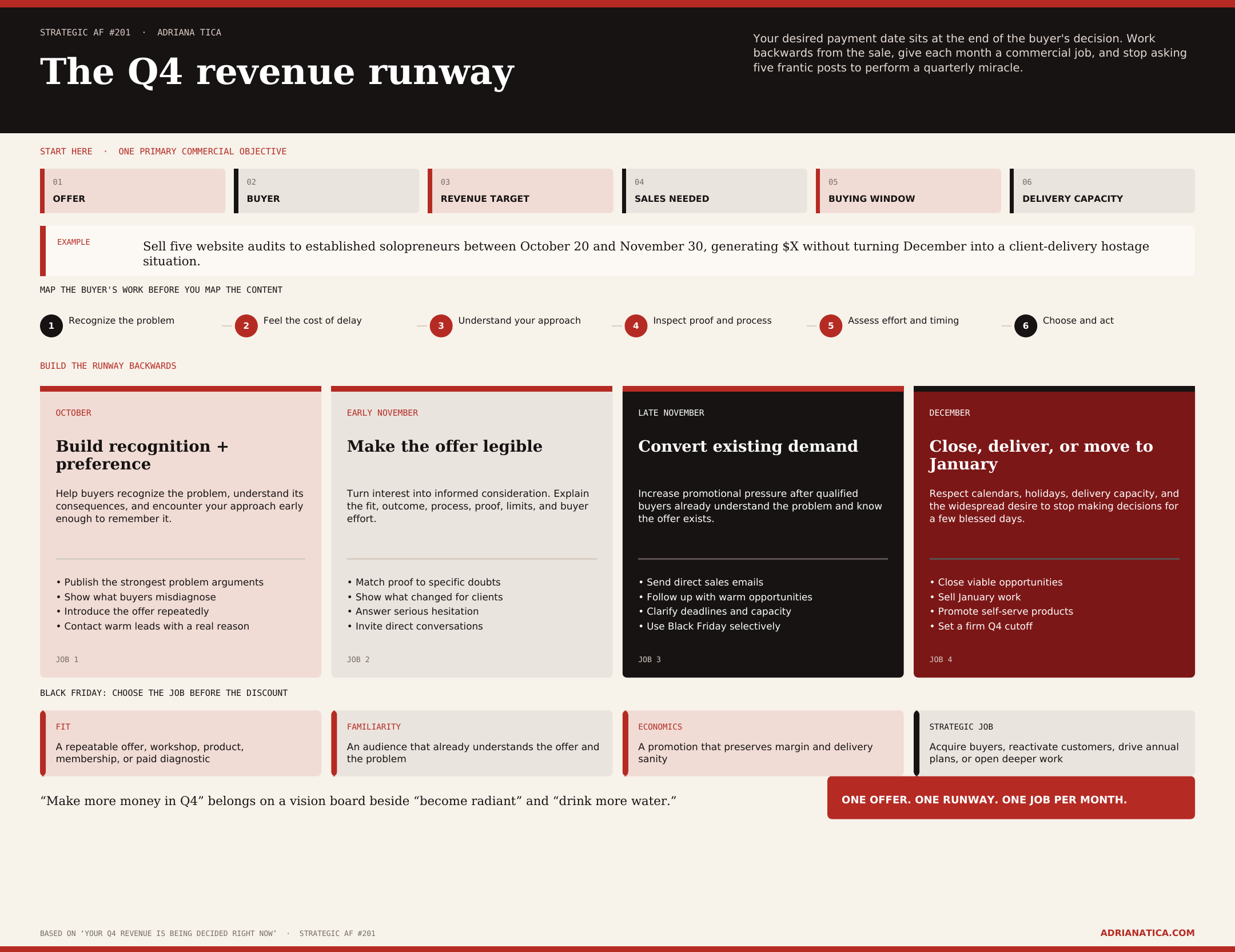
Pick the thing you want to sell
Before building a Q4 runway, choose one primary commercial objective.
One.
I know. Cruel and oppressive.
Choose the offer that matters most to your Q4 revenue and give it the strongest arguments, proof, content, conversations, and promotional windows.
You can continue selling other things. They simply don’t get to storm into the quarter wearing tiny “priority” badges.
A typical solopreneur’s Q4 plan contains a course launch, a service promotion, a Black Friday sale, a newsletter growth push, a new lead magnet, three collaborations, and a solemn intention to rest more.
When everything is important, nothing receives enough sustained attention to work.
Define:
- The offer
- The buyer
- The revenue target
- The number of sales required
- The desired buying window
- The delivery capacity
For example:
“Sell five website audits to established solopreneurs between October 20 and November 30, generating $X without turning December into a client-delivery hostage situation.”
That gives you a target you can build towards because you know exactly how many sales you need to make and how you can split them across channels.
“Make more money in Q4” belongs on a vision board beside “become radiant” and “drink more water.”
Map what the buyer needs before they can say yes
Once you know what you’re selling, list the work your buyer must complete before purchasing.
This is where many sales plans develop a severe case of founder-centric thinking.
You understand the offer because you built it. You know why it matters because you have spent six months thinking about it. Your buyer has been doing other things.
If you’re selling a website audit, they may need to understand:
- Why their problem requires strategic diagnosis
- What delaying the decision is already costing them
- Why another template, course, or AI-generated action plan will leave the underlying problem untouched
- What happens during the audit
- What they will leave with
- Whether their
- Whether they have the capacity to implement the outcome
Every item represents a sales task.
Some require content. Others need a testimonial, case study, FAQ, email, direct conversation, offer-page section, or an example of how you think.
Build your Q4 runway backwards
Start with the desired buying date and work backwards.
Let’s say you want someone to begin an engagement on December 1. This means that:
- They need to sign the agreement by November 20.
- Serious conversations need to happen during the first half of November.
- The prospect needs to understand the problem, recognize your approach, and encounter enough evidence throughout October.
See how your December revenue has an October workload attached to it?
October: build recognition and preference
October is where you create the context for the sale.
Publish the arguments that help people recognize the problem. Show them what they may be misdiagnosing, what the current approach costs, and why familiar solutions keep producing disappointing results.
Introduce the offer early enough for it to become familiar. Note: mentioning it once in an email footer will not create meaningful recognition.
Start relevant conversations with past clients, warm leads, subscribers, collaborators, and people who have previously shown interest. Give them an actual reason to respond because “Just checking in” has the commercial energy of a damp tissue.
By the end of the month, a suitable buyer should understand the problem and know that you offer a way to solve it.
Early November: make the offer legible
Now the offer becomes more prominent and specific.
Explain who it’s for, what changes after buying, how the process works, what the buyer must contribute, what evidence supports it, and where its limits sit.
Address the questions that make good prospects hesitate.
Show the proof near the doubt it resolves. A vague testimonial saying you were “amazing to work with” may warm the heart, but it tells the buyer roughly as much as an Airbnb review praising the presence of soap in the bathroom.
Publish specific evidence:
- What changed for a client?
- What had they tried previously?
- What did you diagnose?
- Why did your approach work?
- Which results mattered?
- How long did the process take?
- What kind of buyer gets the most value?
This is also the moment to start making direct offers and inviting conversations.
Late November: convert the existing demand
By late November, qualified buyers should already recognize the problem, understand the offer, and have enough evidence to evaluate it.
Now you increase the promotional pressure.
- Send the emails.
- Publish direct posts.
- Follow up with warm leads.
- Answer objections.
- Clarify deadlines.
- Hold the sales calls.
- Remind people who the offer serves and what continuing without it will cost.
Black Friday may fit here, or it may have absolutely no business in your strategy — don’t create a Black Friday offer just because everyone does.
Black Friday is a buying event, not compulsory business cosplay
Black Friday falls on November 27 this year.
Online spending during Black Friday remains enormous. Adobe reported that US consumers spent $11.8 billion online on Black Friday 2025, an increase of 9.1% over the previous year. The National Retail Federation reported that 202.9 million US consumers shopped during the five days from Thanksgiving through Cyber Monday, with Black Friday remaining the most popular shopping day.
Yes, Black Friday creates buying intent. It also produces an industrial quantity of noise.
Your customers’ inboxes will fill with discounts, bundles, bonuses, expiring bonuses, extended bonuses, final extensions, and several “I never do this” promotions from people who did precisely the same thing last November.
Joining that circus requires a commercial reason.
Black Friday may work well when:
- You sell a digital product, workshop, membership, or repeatable service.
- You sell low-cost products and bundles that scream “impulse purchases”
- The promotion can accelerate an existing decision.
- The discount preserves solid margins.
- You want to reactivate previous buyers.
- The offer creates a useful path into deeper work.
For high-trust services, bespoke consulting, or work with limited capacity, a large discount can create more problems than sales because selling premium judgment at 40% off makes the positioning look as coherent as a luxury surgeon handing out Groupon codes.
You still have options, though.
You could create a bundle, add an implementation session, reward an annual commitment, reopen an existing product, offer a smaller paid diagnostic, give current subscribers a private incentive, or release a limited number of January slots.
You could also use Black Friday to drive a completely different commercial result. For instance:
- Acquire new buyers through an entry offer.
- Move existing customers into an annual membership.
- Fill a workshop that naturally leads into consulting.
Choose the job before choosing the discount.
December still sells—within the boundaries of time and physics
December often gets treated as one of two things: a magical sales wonderland or a commercial wasteland where every prospect has entered hibernation.
Neither assumption helps.
People still buy in December. They also travel, close annual projects, use remaining budgets, plan the next year, attend school events, recover from Black Friday emails, and experience the ordinary human desire to stop making decisions for a few days.
Your December plan should reflect your buyers and your offer.
- Follow up with active opportunities.
- Confirm remaining capacity.
- Clarify the final date for starting in Q4.
- Sell January work while planning energy is high.
- Promote products that people can use independently.
- Give interested buyers a clear next step.
Then set a cutoff.
An interested person who cannot realistically decide, pay, onboard, and begin before the holidays belongs in your January pipeline. Move them there.
Need help planning your Q4
Strategic decisions are what we do best in The Council. If you need help prioritizing what to sell in Q4 and how to do it, join us!
Want this as a downloadable planner?
My brilliant friend Bryan Yates showed me a one-pager he had Claude create based on a previous newsletter issue of mine, and I shamelessly stole his idea.