“Hello, Bucharest! We are Metallica!” were the first words James Hetfield said on stage, and 65,000 people lost their minds. I was one of them.

I grew up listening to Metallica, and seeing them live was really high on my bucket list. As I write this, I can still feel the shivers running down my spine; 14-year-old Adriana would be so damn happy.
Almost a year before the concert, I woke up early to take my seat in the digital queue for tickets — because they are Metallica and I knew they’d be sold out in minutes (they were).
I bought good seats without questioning the price because they are Metallica.
I showed up to the venue expecting to have the time of my life because they are Metallica (I did).
As I got home after the concert and the high was waning off, I remembered his words — simple, to the point, and very confident, yet somehow humble (he still introduced the band by name, not that anyone was confused about who was on stage).
When I heard him say “We are Metallica”, the only thought that crossed my mind was “yeah, you f-cking are!”.
See, whether you love their music as I do or not, you can’t question the fact that they are the metal titans. They’ve been at it for 45 years!
After 45 years of filling up arenas all over the world, you expect them to have sky-high confidence. You don’t question it — they’ve earned it. They are rockstars, and they show up as such.
You know who else shows up as a rockstar, though? People who learned a new topic three Thursdays ago and bought a microphone (gosh, I miss the times when microphones were expensive).
Unlike Metallica, the loudest experts in the business world are usually the ones with the least amount of experience but with confidence galore.
We now live in a world where:
- Confidence scales faster than competence
- Certainty spreads faster than nuance
- Performance often beats depth in the attention economy
And if you’re an actual expert, you’ve probably felt this shift viscerally over the past few years. (Have you? Reply and let me know.)
You explain complexity carefully.
Someone else screams “JUST DO THIS ONE THING” into a ring light and gets 4.7 million views plus a sponsorship from a mushroom coffee company founded six minutes ago.
It feels like a deeply unserious timeline, doesn’t it?
We’ll explore why this happened and what you can do about it after a quick message from today’s partner, my dear friend and one of the few people with deep expertise, NOT cardboard confidence.
📣 Brought to you by 📣
Running’s for Fugitives
Ever have that “I’m running like a fugitive who’s forgotten to exhale” feeling? My friend Bryan Yates coaches insanely capable entrepreneurs who have lots of motion but not much momentum. His monthly essays find what keeps you on the run—so you can shift your physics and build a thing you’re proud of.
I’ve never met anyone who can tell you exactly what you need to hear, whether it’s what you want to hear or not. Until Bryan.
Want your name up here? Reserve your slot! (Sold out until July)
First off, let’s make one thing clear: what changed is not the demand for expertise. Demand is still there. In many industries, it’s growing because markets have become more volatile, more competitive, and significantly noisier.
What changed is the way people recognize expertise.
That recognition system got so distorted that you no longer need an arena filled with people screaming your name to be an expert or a rockstar. You just need to project that image.
The internet rewards cognitive ease
Humans use shortcuts to evaluate credibility. We always have — this is not something new.
Psychologists call these heuristics, a word that defines the process we use to infer competence from signals:
- Confidence
- Fluency
- Familiarity
- Repetition
- Visual polish
- Social proof
The problem is that these signals are imperfect proxies for actual expertise. I got a lot of pushback on my latest YouTube video, where I talked about how B2B influencers duped us.
I had the audacity to say that maaaaybe you shouldn’t listen to the advice of the Gary Vees and the Hormozis out there — not because it’s bad (it often isn’t) but because it ignores context and gets you benchmarking your business against unrealistic standards.
And yes, people didn’t understand how I dared to speak against the business titans (titans?).
Research from the University of Waterloo found that people often conflate confidence with competence, especially in uncertain environments, and that confidence predicts influence better than accuracy in groups.
That dynamic becomes dramatically stronger online because audiences evaluate people quickly, and context collapses into bite-sized fragments:
- A post
- A clip
- A thread
- A carousel
- A thumbnail with an expression that suggests the creator just unlocked all the mysteries of life.
The internet compresses evaluation time.
Actual expertise tends to expand context, whereas social media rewards compression and brevity.
See why it’s hard to spot real experts? It gets even more confusing.
Real experts communicate differently
Experienced people often sound less certain because they’ve seen edge cases, tradeoffs, unintended consequences, timing variables, and exceptions. The person who’s only worked on one business their entire career? They don’t question anything!
One of the questions I get asked most often on podcasts is “What advice would you give someone who’s just starting out?”
I do my best to find a blanket answer but, candidly, I f-cking hate that question.
Just like I don’t offer the same playbook in two different strategy sessions (because people and contexts are different), it’s hard to answer a question about an imaginary beginner.
My knee-jerk reflex is to give the most hated answer in the world: “it depends”, then ask a series of questions of my own: what industry are they in? How big is their network? Do they have a financial cushion? What are their business skills?, and so on.
But people don’t want that because they mistake simplicity for mastery.
That gap creates a strange market dynamic: the people with the shallowest understanding often communicate with clean certainty:
- “Just niche down.”
- “Just raise your prices.”
- “Just post every day.”
- “Just build a personal brand.”
Meanwhile, actual experts tend to say: “Well, it depends on your category dynamics, buying cycle, positioning, trust maturity, market sophistication, margins, and business model.”
Guess which version spreads faster on TikTok. The algorithm would like you to dance now.
This is where the Illusion of Explanatory Depth meets the Dunning-Kruger effect. People with limited knowledge oversimplify complex matters to death and come up with catchy sound bites, but zero applicable meaning.
Another challenge is that expertise has become harder to evaluate
Part of this is volume: the amount of content produced online has exploded, and AI has accelerated it even further.
This is propaganda 101: repeated exposure increases perceived truthfulness, even when information is false. Psychologists call this the “illusory truth effect.”
Repetition creates familiarity, and familiarity creates perceived credibility.
This helps explain why some creators feel omnipresent despite saying roughly the same three things in twelve different hoodies.
The issue becomes even more pronounced in industries where outcomes are delayed and difficult to measure:
- Marketing
- Business strategy
- Leadership
- Investing
- Wellness
- Personal development
If results take months or years to emerge, charismatic storytelling fills the evaluation gap.
Humans are narrative-driven creatures. We want coherent explanations. We want certainty. We want causality.
The person who says “Here are the 14 interacting variables and why timing matters” rarely goes viral and, sadly, gets perceived as an expert even more rarely.
The expertise economy became a performance economy
This is where real experts get trapped: they assume they’re competing on knowledge when they’re competing on signal transmission.
Those are very different games.
You can be exceptional at your craft and still struggle to communicate value in a crowded information market.
Because expertise alone does not create perceived expertise.
Visibility architecture matters:
- How you frame ideas
- How consistently people encounter you
- How clearly you articulate problems
- How memorable your positioning becomes
- How effectively you reduce cognitive load
This is one of the reasons I keep talking about trust, credibility, and The Resonance Principle.
People rarely evaluate you through a single interaction; instead, they build probabilistic impressions over time.
This applies to personal brands and expert-led businesses too.
People hire:
- The expert they remember
- The expert they understand
- The expert whose thinking feels coherent
- The expert whose ideas stayed with them long enough to become mentally available when the buying trigger appears
That last part is huge because expert-led businesses often operate on delayed trust cycles. Someone may spend 6-12 months reading your content, but will only buy when their pain becomes throbbing.
And now they need the person whose ideas already occupy mental real estate.
The response to this problem is usually terrible
A lot of smart people react to this environment by trying to imitate high-arousal creators. They increase volume, they increase hot takes, they flatten nuance, they manufacture certainty, they optimize for reaction.
Eventually, their positioning drifts away from the thing that made them valuable in the first place.
This is why so many experts secretly feel trapped by content: the internet trained them to perform expertise instead of deepening it.
And ironically, audiences are getting more skeptical of performance-heavy branding because they’ve been burned repeatedly.
The good news is that we are entering a market phase where:
- Trust matters more
- Discernment matters more
- Consistency matters more
- Intellectual honesty matters more
The loudest people still dominate visibility in many spaces, but buyers with actual budgets are becoming more careful.
Very careful.
So what do you do if you’re an actual expert?
First and foremost, you stop treating visibility and expertise as opposing forces.
Most people swing between extremes:
- “Just focus on the craft.”
- “Just focus on content.”
- “Just focus on distribution.”
Strong positioning requires integration — you need all three.
Here’s how to get them:
1. Translate complexity instead of displaying it raw
Your audience does not need the full operating manual on first contact. They need orientation before sophistication because, remember, YOU are the expert, not them — that’s why they’re hiring you.
So, start with:
- Recognizable problems
- Observable symptoms
- Emotional stakes
- Concrete consequences
Then expand the nuance gradually.
I strongly believe that the real “game” is being able to compress complexity without mutilating it.
2. Develop recognizable intellectual territory
Many experts sound interchangeable online. Their advice may be correct, but nothing about it sticks.
Memorability matters.
This is why frameworks, recurring concepts, original language, research, and distinct perspectives matter so much.
People remember the sound bites because distinct language creates retrieval cues in memory.
The real question is: can you create sound bites that have depth?
3. Show judgment, not just information
AI made information abundant, which is precisely why judgment became more valuable. As my friend Bryan likes to say, “your perspective is your product”.
People increasingly pay for:
- Interpretation
- Prioritization
- Synthesis
- Contextual thinking
- Discernment
The internet has infinite tactics, so what buyers need now is help deciding. This is why our group sessions in The Council are called “Decision Clinics” — almost everyone is drowning in infinite options, so I want to help them decide faster and better.
4. Build proof that compounds
Compounding proof goes beyond testimonials and social media likes (not that those aren’t important). Think:
- Case studies
- Original research
- Longitudinal observations
- Frameworks
- Testimonials with specifics
- Repeat buyers
- Referrals
- Ideas people quote back to you later
This kind of proof matures slowly and, more importantly, it also survives algorithm changes much better than performative virality.
5. Accept that expert-led businesses often move slower
This is frustrating, I know, especially after years of exposure to “$100k in 90 days” business propaganda.
High-trust businesses frequently grow through cumulative exposure and layered credibility.
It’s OK if you’re not a millionaire in your first year in business. In fact, it takes an average of 3 years to build a 6-figure solo business (stat from State of Solopreneurship).
The opportunity hiding underneath all this
I actually think this shift creates an advantage for real experts: the market is becoming saturated with synthetic confidence.
People can feel it.
They may not always articulate it cleanly, but they feel the texture of overperformed certainty and recycled thinking, which means coherent expertise becomes more valuable over time.
Especially expertise paired with:
- Clarity
- Consistency
- Emotional intelligence
- Restraint
- Intellectual honesty
The people who come out of this era strongest probably won’t be the loudest. But they’ll be the ones who become deeply trusted reference points in their category.
They’ll be the ones who say: “Hello, I’m [name]” and people will lose their minds.
I know, that takes longer. The good news is that it also compounds harder.
Feel like your expertise is undervalued?
I keep hearing that business got harder, especially for expert-led companies. I can’t tell you why it feels that way for you, specifically, without knowing where the gap is.
I can, however, tell you that it probably has something to do with your content, your distribution, or how you package your expertise.
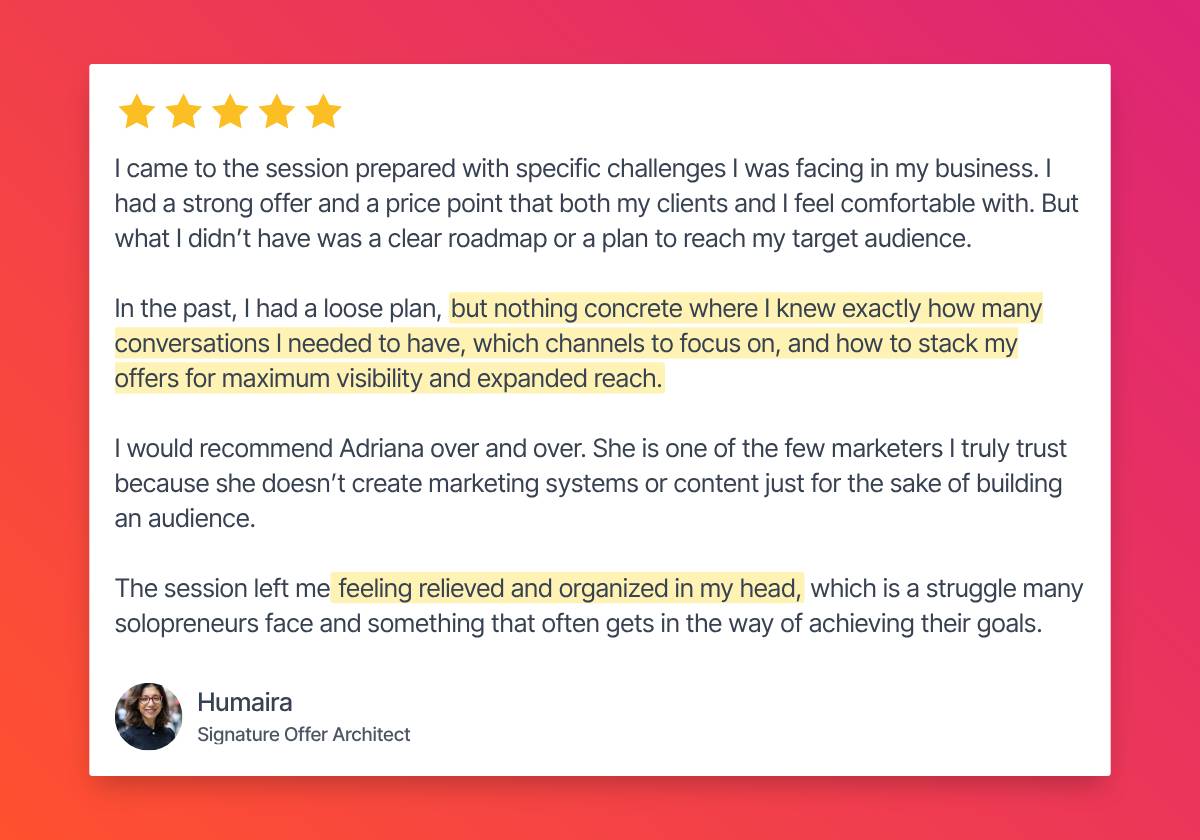
For advice that works for you, I strongly encourage you to book a strategy session with me. We’ll analyze your context and come up with a plan that fits your strengths and your needs. Odds are you’ll leave the session with much-needed clarity, as Humaira did.