
People rarely book a Strategy Session because they have no ideas. They usually have twelve.
They’re wondering whether to launch the course, raise their prices, create a membership, start a newsletter, abandon the newsletter, post more often, move to YouTube, fix the funnel, hire a salesperson, or finally turn that suspiciously popular spreadsheet into a $49 product with its own software stack and emotional-support launch calendar.
This is why I rarely spend a Strategy Session answering the original question immediately. The question matters, but it often sits several layers below the decision that will actually change the business.
For instance, “Should I start posting on YouTube?” may be a channel question.
It may also reveal that the current content reaches peers instead of buyers, the newsletter has no commercial role, the offer requires more trust than short-form content can build, or the founder has consumed seventeen videos insisting that YouTube is the final vessel leaving Algorithm Hell.
Answering the question without understanding what produced it would be wonderfully efficient. It could also waste the next six months.
Step 1: Identifying the tactical hats strategy questions wear
Most business problems first become visible as tactical annoyances.
Sales are slow → more content
Delivery is exhausting → higher prices
The launch disappointed you → a sacrifice to the conversion gods
Some of those prescriptions may help because the symptoms are real.
However, symptoms make unreliable strategists.
Sure, a weak launch can come from poor promotion. It can also come from an offer people never wanted urgently enough, an audience full of the wrong buyers, insufficient proof, terrible timing, a long trust-building cycle, or expectations based on somebody else’s revenue screenshot.
I also look at benchmarks, REAL benchmarks, from industry reports, like The State of Solopreneurship. In case you missed last year’s edition, here it is.
The TL;DR of what I do: I’m trying to find the expensive problem.
The expensive problem creates uncertainty, waste, or fragility everywhere downstream. Resolve it, and several smaller problems become easier. Ignore it, and you can spend months polishing its symptoms.
Step 2: I listen for contradictions
Clients tell me what they want, and oftentimes, they describe a business that keeps funding something else.
For instance, they want predictable revenue, but every offer requires a launch.
The most common contradiction is this: they want to build an asset, yet urgent client work takes every available hour. The newsletter, framework, referral system, or signature offer gets moved into the mythical future week when nobody needs anything.
These contradictions interest me far more than whether the latest carousel performed well.
Your business is always expressing a strategy through its allocation of time, money, and attention. It may simply be expressing a different strategy from the one in your planning document.
When the stated goal and funded behavior disagree, I believe the funded behavior.
My job is to find the contradiction and make the trade-off visible.
Because “I want to grow my newsletter” sounds reasonable.
“I want to grow my newsletter while spending no more than two hours a week on it, continuing to serve six clients, launching three products this quarter, posting daily on LinkedIn, and maintaining a deeply meaningful relationship with sleep” gives us something useful to discuss.
Step 3: I separate evidence from emotional fan fiction
Every solopreneur has evidence. They also have stories they have repeated so often that the stories have been promoted to evidence.
I’ve seen clients make decisions on a single flop or vice versa: decide to build something just because one person told them they should.
That is where an outside brain earns its keep. I have no emotional attachment to the course you have been planning since 2023. I can examine the available evidence coldly, ruthlessly, and tell you when you’re getting high on your own supply or when you’re selling yourself too short.
Spoiler alert: most of my clients are guilty of the latter, not the former.
Step 4: I look for the hidden subsidy
A business can appear healthy because something else is quietly paying its bills: one large client, a legacy audience, or unpaid founder labor.
The offer looks profitable because nobody counted the research, selling, preparation, admin, revisions, customer support, emotional recovery, and the two hours spent thinking about the client’s problem while allegedly watching Netflix.
The revenue is real but so is the labor.
This matters because people often ask how to grow something before establishing what currently keeps it alive.
- If your low-ticket product sells mainly because you have spent five years building trust through a newsletter, the product and the newsletter belong to the same economic system.
- If your consulting pipeline depends on referrals from two long-standing partners, your acquisition strategy contains more concentration risk than “most clients come through word of mouth” suggests.
So I want to see the complete machinery. Otherwise, we may optimize the visible offer while cheerfully dismantling the invisible asset supporting it.
Step 5: I find the decision you’re trying to avoid
Some clients need information, that’s true. But most already know enough to make a decision. This shows up like wanting the stability of consulting, the leverage of products, the intimacy of a community, the authority of a newsletter, the reach of video, and weekends.
Here’s the thing, though: strategy creates loss by design. Time, money, and attention move toward one possibility and away from another. A decision that protects every option usually protects the confusion too.
This is where decision debt enters the business. Every unresolved upstream choice produces more downstream deliberation.
My job is to look for the decision creating the most downstream uncertainty.
Then we examine the evidence, expose the trade-offs, and decide whether the question genuinely needs more time or has merely been granted diplomatic immunity.
Final step: your strategy has to fit the person implementing it
I could prescribe newsletters to everyone. Mine has built my audience, generated clients, sold my offers, and created opportunities I could never have engineered through cold outreach.
I still advise some of my clients against starting one because recommending my preferred channel would be the business equivalent of prescribing everyone the same glasses because I can see well through mine.
This is one reason great business advice keeps failing smart people. Advice usually arrives stripped of the context that made it work.
A creator selling a $29 template needs a different acquisition system from a consultant selling $10,000 engagements.
Your strengths matter. So do your aversions, capacity, margins, cash position, audience, risk tolerance, reputation, existing assets, and desired relationship with the business.
“Best practice” can take a seat while we figure out whether the practice belongs anywhere near your life.
Want to apply this yourself? Download the expensive problem audit.
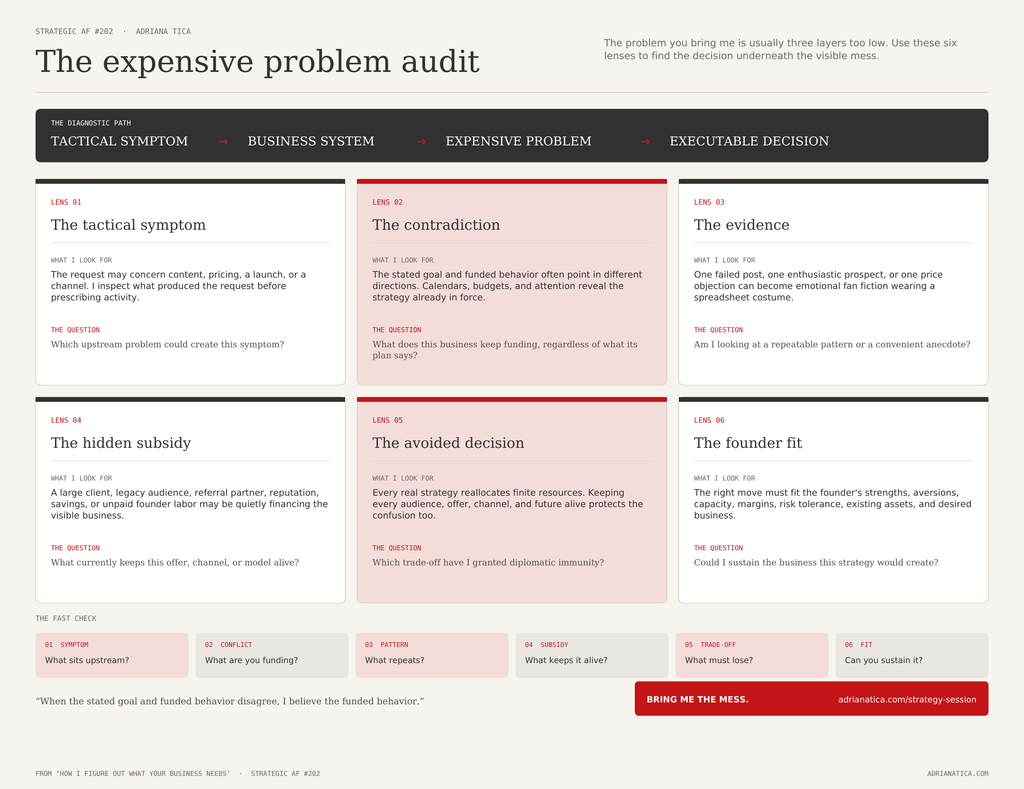
The goal is a decision you can execute on, not more tactics
People occasionally expect a strategy session to produce a secret tactic, that ONE word you can change on your landing page and 10x your conversion rate or that ONE thing you can do to add $10k/month tomorrow.
After working with hundreds of brands, I do have plenty of tactics. Some are even useful.
But the bigger value comes from diagnosis.
You bring me the visible problem, competing ideas, partial evidence, old commitments, appealing distractions, and facts that feel equally important because you live inside all of them.
I look for the structure.
- Which problem sits upstream?
- Which opportunity has evidence behind it?
- Which attractive possibility becomes commercially ridiculous once we account for the complete workload?
- Which decision would simplify everything downstream?
Then we decide what deserves attention now.
That final word matters. Strategy has a time horizon. A sensible decision today may deserve review after a launch, a quarter of evidence, a market change, or a meaningful shift in the business.
You may need someone who can tell which one deserves your next six months—and which ones should be removed from life support before they acquire another Notion dashboard.
If your business feels messy or your options keep multiplying, book a Strategy Session with me.
Bring me the mess. I’ll find the decision underneath it.