
You may not know this about me: I’m pretty good at being consistent in (some) things. For instance, I have a Duolingo streak of more than 1,900 days.

That’s over five years of opening the app every single day, completing a lesson (sometimes 10+), and satisfying the passive-aggressive green owl who would presumably dispatch armed men to my house if I ever stopped.
It’s an impressive streak. My Greek is considerably less impressive.
I learned a fair amount through Duolingo, of course. Repeating something in the same context helps turn it into a habit. They say that your habits shape who you are — do things consistently, and you’ll get good at them eventually.
Me? I got good at keeping a streak that I’m weirdly proud of because Duolingo made it very easy for me to practise Greek every day.
BUT it did not make me good at Greek by itself (which is what I wanted it to shape me into).
For that, I had to practise outside the damn app. I had to use what I learned in situations where the answer wasn’t waiting inside a multiple-choice box, and a cartoon character couldn’t congratulate me for correctly identifying the pink avocado.
Yes, the streak built the routine and laid the foundation. But real improvement required constant exercise, application, feedback, and occasionally making a fool of myself while talking to native Greek speakers.
This is the distinction that is missing from most conversations about consistency, especially in marketing.
Speaking of consistency, have you ever thought about what could happen if you only did marketing for 2 hours a week? My friend and brilliant consultant Dr. Michelle Mazur has been helping experts learn where to put their focus to make every minute count.
📣 Brought to you by 📣
Dr. Michelle Mazur
You don’t need more marketing tactics. You need the three that fit how your clients buy. In her free live workshop on August 25, messaging strategist Dr. Michelle Mazur shows you how to build a marketing plan that takes two hours a week.
You leave with the plan finished — right as your buyers get back to their desks.
Want to get all the clients you want marketing just 2 hours per week (yes, really!)?
Get your 2-hour marketing plan for $0!
Want your name up here? Reserve your slot! (Sold out until September)
Consistency is a mechanism
“Be consistent” may be the most widely prescribed advice in online business. The idea for this edition came when my Instagram algorithm presented me with 3 reels from 3 different people who all said the same thing: “Post every day for a year and watch your life change”.
Publish consistently. Email consistently. Promote consistently. Show up consistently. Keep going consistently until the algorithm notices your admirable work ethic and presents you with several premium clients or sponsorship opportunities.
This advice is inescapable online and it’s not completely wrong, either. So let’s start by looking at why consistency helps.
First off, it helps because repeated action lowers the friction of starting. You develop a routine, become faster at the work, and stop negotiating with yourself every time something needs to be published.
And yes, all that matters, according to behavioral research. But what most people miss is that the gains eventually plateau: repeating the same behavior continues the habit, while producing progressively smaller increases in automaticity and gradually smaller gains.
Think about it this way: going to the gym thrice a week is a healthy habit, and pushing yourself to do it for a few months is useful — you need it to become your status quo. BUT if your gym routine never changes, your gains will get gradually smaller until you see no additional benefits.
In business, this means you can become extremely efficient at repeating an activity whose commercial value remains somewhere between “unclear” and “absolutely f!ck-all.”
- You can publish every day and attract people who enjoy your writing but will never buy.
- You can send a weekly newsletter that has no defined role in your customer journey.
- You can promote an offer consistently when the offer itself needs work.
- You can repeat a message that attracts peers, beginners, freebie hunters, or people who agree enthusiastically and then disappear whenever money enters the conversation.
- You can spend years building an audience around a topic you no longer want to monetize.
I’ve seen all this happen (in my business occasionally, too).
If you can’t tie consistency to actual goals, consistency becomes a force multiplier for a strategic mistake.
I invite you to build a better relationship with consistency starting with this:
Give your consistency a job
“Publish three times a week” describes an activity. It says nothing about what those repetitions are supposed to teach you, change, or create.
This example is about content, but it can apply to everything in your marketing. Before committing to a (publishing schedule), ask what you want to know or achieve by the end of it.
A few examples:
- You might want to test a positioning hypothesis. Perhaps you believe a particular type of buyer has an urgent problem you can solve. Publishing around that problem lets you observe who recognizes it, how they describe it, which consequences matter, and whether they have any appetite for solving it.
- You might want to identify resonant problems. Some subjects collect casual agreement, while others prompt people to tell you detailed stories, ask follow-up questions, or admit they have been struggling with the exact situation for months.
- You might want to learn which expertise people associate with you. What do people ask you about? When do they tag you? Which statements do they repeat back to you? What would they confidently refer someone to you for? Your intended positioning and your remembered positioning can be two very different beasts.
- You might want to generate qualified conversations. This requires looking beyond engagement and noticing who engages, what they say, and what happens next.
- You might want to develop ideas worth expanding elsewhere. Short-form publishing can help you pressure-test an idea before turning it into a newsletter, workshop, product, talk, or service. You learn which framing catches attention, which claims need more evidence, and which parts people misunderstand.
Each of these objectives changes what you publish, what you measure, and what you put your energy into.
And it’s exactly the same approach we’ll use for our Threads challenge. Sure, you’ll be posting (perhaps more frequently than before) but, before you do, you’ll give your consistency a real job and a real goal.
The goal is informed consistency
Last week, we spoke about recurring marketing for recurring revenue. Yes, recurring marketing requires consistency. Yes, you still need to show up.
But that’s just the table stakes. A useful consistency goal should answer four questions:
- What am I repeating? Define the subject, message, offer, behaviour, or expertise you want to reinforce.
- What do I expect to happen? State the hypothesis. Get specific enough that the hypothesis can be invalidated (that’s the scientific approach).
- Which signals will matter? Choose indicators connected to your objective: qualified replies, sales conversations, referrals, subscriber growth, offer interest, or the language people use.
- When will I review and adjust? Decide when you will interpret the evidence. Otherwise, you will keep pu(bli)shing until the streak itself becomes the achievement. (Ask me how I know.)
I’m insisting on the goal-setting part because our brains like to screw us over
When the evidence is messy, we interpret it according to whatever we already wanted to believe.
- High engagement confirms the idea. OR low engagement proves the algorithm is broken.
- Sales confirm demand. OR silence means people are “still warming up.”
See where I’m going with this? Confirmation bias lives in every single one of us, which is why we often need an external brain (or more) to help us separate evidence from emotional fan fiction.
This is exactly the kind of thing we do in The Council — we stop the navel-gazing, and we help each other with real feedback that moves the needle. Like it happened for Glen.
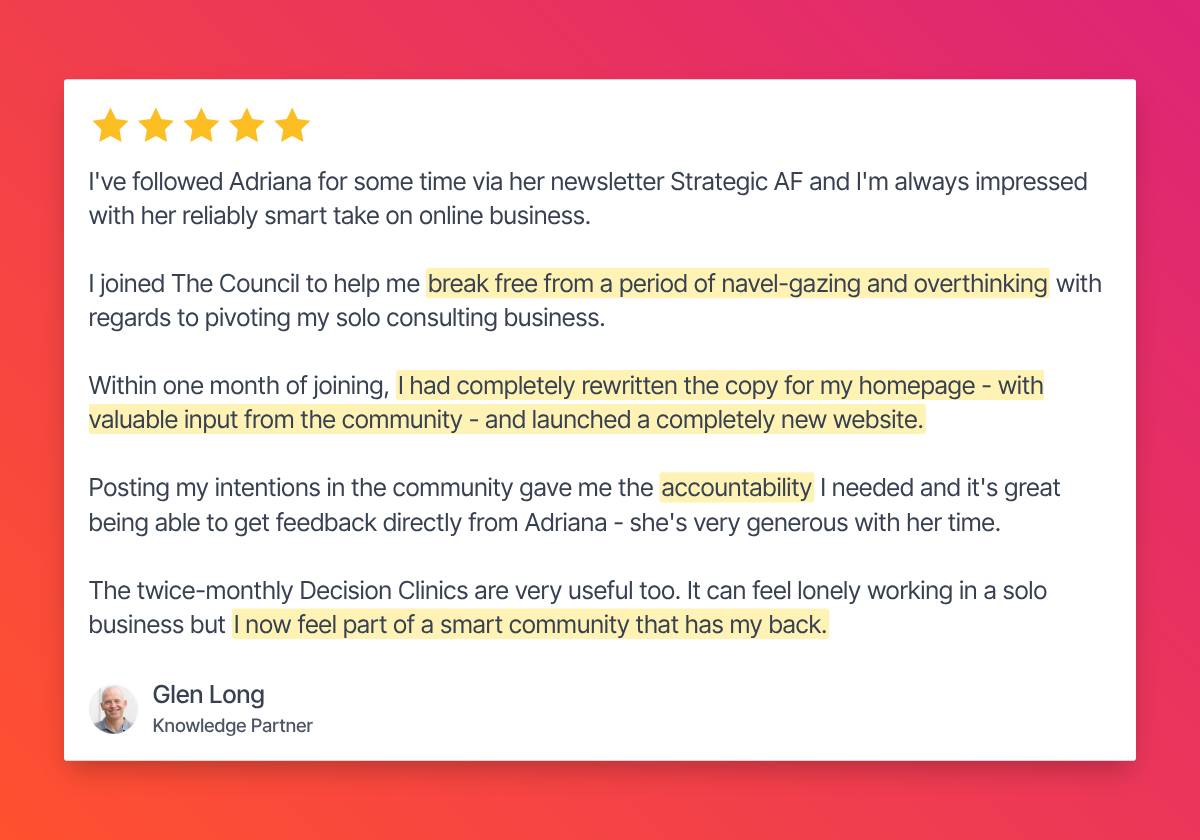
Oh, and, BTW, if you’re a Council member, the Threads challenge is free for you. If you’re not, this is a great time to join us.
If you only remember one thing from this edition, make it this one: consistency for consistency’s sake means nothing in business and marketing. Give your consistency a goal before anything else.