At the beginning of the year, I told you about my strategy and how this question (“What’s one HARD thing that I can do and that no one else in my industry wants to do?”) lies at its core.
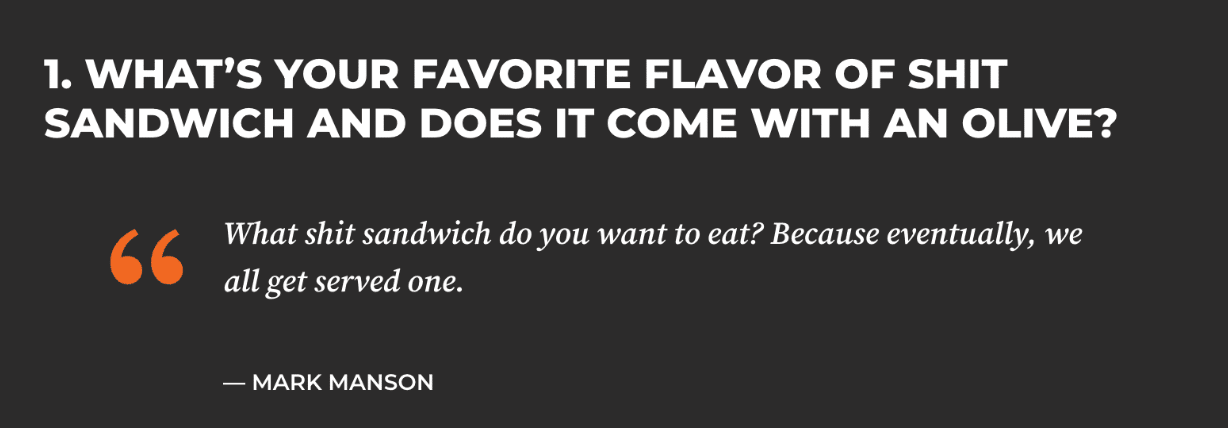
This is the question that fueled my strategy. It’s a paraphrase rooted in some of Mark Manson’s ideas that we all eventually go through hardship — and that we shouldn’t try to avoid the hard things. (I heard about it from someone else, but for the life of me, I can’t remember who, so please forgive my incomplete citation.)
Mark Manson often phrases it in more plastic ways:
I’ve begun thinking about this because, as I told you last week, attention is harder to get today BUT still very much needed. So you can’t grow if you do what everyone else is doing; you need to think beyond the basic things.
Here’s a quick recap of how it worked thus far:
First answer: State of Solopreneurship
My first answer to this question was the State of Solopreneurship report, which worked very, very well. It now accounts for roughly 10% of my current email list.
And yes, it was hard AF to build it. I’ll be doing it again this year.
Second answer: The Council
Building and managing The Council exceeded my expectations in every respect. Yes, it’s hard too but:
- It’s also much easier to sell than I expected.
- It is now my favorite corner of the internet: the depth of discussions, the way people show up for each other, the smart questions they have — all of these act like fuel for me.
- It’s the nexus that I needed for my offers.
So, no regrets so far. Better yet, both of them are things that compound and increase my authority in the space.
There are two new hard choices I’ve recently made, and I want to unpack them with you today.
I’ll tell you about them in a second, after a message from today’s partner and dear friend, Ellen Donnelly, one of the few people in this industry who talks about that elusive compounding authority the right way — with no hype, no overselling, and no overpromising.
📣 Brought to you by 📣
The Authority Entrepreneur Quiz
Coaches and consultants get so focused on delivering well for their clients that their own business gets left feeling scattered, hard to explain, or overly reliant on them showing up.
To grow a practice that truly compounds, building authority is the answer. Discover where you’re at on your journey to Authority Entrepreneur status with this free assessment from business coach Ellen Donnelly, and get your personalised roadmap on where to focus next.
Want your name up here? Reserve your slot! (Sold out until June)
Candidly, I don’t know if the next two things I chose are hard for everyone or just for me. What I do know is that they both stem from the same very long history of leaning on inbound marketing — written content to be precise.
Focusing on outbound and outreach
Save for when I first started out on freelancing websites, where pitching was the norm, I’ve never done outreach. My agency clients came through SEO content, referrals, and guest posting — all pure inbound strategies.
In this business, all my clients came from social media, newsletter content and referrals. The same goes for all my partnerships.
Save for a few cross-promo partners that I picked up by asking in private communities, every partnership, every joint event, every online summit I’ve spoken to, every podcast I’ve ever been on, all came to me without asking.
I went entire quarters without reaching out to anyone — but I did reply to the messages I got.
However, I recently had to begrudgingly admit that it’s no longer enough and that I need to get serious about outreach and proper selling.
I don’t think I’ll ever be the person who sends cold DMs, but I noticed that starting conversations moves the needle much faster than waiting for the others to do it. Shocking, I know.
So my current approach to light outreach is:
- If I see something I like, I DM people to congratulate them about it. There’s no hidden agenda here, and yet, these conversations landed me a couple of podcast invites in the last two months alone.
- If someone engages with my social media posts, I DM them. Not all of them, of course.
- If someone engages with a social media post of mine where I promote a product or a service, I DM them to see if they have questions about it. Again, not all of them. I always start with people I already know.
That’s it. That’s everything I do — for now, at least.
Since we just kick-started an outreach sprint in The Council, I’m looking forward to the guest sessions to figure out how to fine-tune my approach.
I hand-picked our guests so that Council members get a well-rounded approach to outreach, from mindset and strategy to tactical advice.
So I might update you on this approach of mine soon.
For now, I’ll just say this: even if I do the bare minimum in terms of outreach, I’ve still seen a major spike in sales, partnerships, and other opportunities. Not a week goes by that I don’t get one of these.
Getting started on YouTube and video in general
I’ll always be a writer first and foremost, but I finally started taking video seriously. My YouTube channel now has 4 (!) videos (gasp!). I’m already seeing major improvements between my first public video and my most recent one.
The thumbnails are better, the light is better, and even the way I speak is better. It’s also probably why my latest video has got more views in a short time than everything else I’ve published.
Is it hard? OMG, YES!
I feel like a deep-sea diver in space, but I’m also learning a lot, and I’m ok with things not moving as fast as they do on other social media platforms.
Since I’m already doing long-ish form video content, I’m thinking about chopping some shorter videos from them and using them as YouTube shorts and/or publishing them on other platforms too.
We’ll see. I’m in no hurry, and I also don’t want to spread myself too thin on too many platforms at once.
Why am I doing this to myself (and why you should consider it too)?
Listen, I know all humans have the reflex to recoil from doing hard things. But there’s one other thing that’s universally true: if you want exceptional results, you have to do exceptional things.
In marketing, this often means doing the things no one else is willing to take on. They don’t have to feel like pulling teeth; they just have to be not ordinary.
Sometimes, you can pull that off with a quick hack, an unexpected gimmick, a campaign à la PT Barnum, a shockwave, and so on.
But those are short-lived things.
Here’s how I choose my hard tasks aka 💩sandwiches
Everything I choose to do has to meet two of three criteria:
- It has to align with my brand ethos (this one’s non-negotiable)
- It has to have a compounding value (evergreen rather than short spikes; things I can re-use or things that gain attention and trust on their own)
- It has to be uncommon among my peers. If everyone does it, it’s table stakes.
Thus far:
- State of Solopreneurship checks all boxes
- The same goes for The Council
- YouTube theoretically has a compounding value because the platform is a search engine. I’m still calling this an experiment; we’ll see if this holds true after three months or so. However, it’s not that uncommon among marketing people.
- Weirdly enough, I’m finding that outreach too has a compounding value. Yeah, it’s very hit-or-miss, but people do remember you better if they’ve had a 1:1 conversation with you, even if it didn’t lead to anything right away. And it’s still fairly uncommon.
Your mission, should you choose to accept it
Take a look at your industry and figure out what very few people are doing precisely because it’s hard. Research reports are something that holds true across industries: very few people create them, and your audience is definitely starving for them because they can’t be replicated with AI. Better yet, they get quoted by AI.
Beyond that, the world is your oyster.
Think about channels your peers aren’t on (social media or not). Could you be there consistently?
Formats are another good place to start: social media posts to books, talks, and summits, there are hundreds of options that feel very heavy, so people default to what’s common.
You probably already know what you need to do, just like I’ve known for a while that I need to start taking video seriously. If you’re still procrastinating, I want to let you in on a little secret:
If it’s uncommon in your industry, the standards are very low.
People don’t expect you to put together a masterpiece on your first try. This is not to say that you should half-ass it; just that you get to define the standards.
If you downloaded State of Solopreneurship, you’ve probably noticed it doesn’t look as good as a McKinsey report. Could it be better? Sure!
But, unlike McKinsey, I don’t have a team. I put this together on my own, and I believe that its real value stems from its independence. Since it’s not funded by any big corporations, it paints a realistic picture of the industry.
So, if you’ve been holding back because you don’t think that you can create something impressive AF, this is your sign that you don’t have to. It doesn’t have to be perfect, and you absolutely don’t have to meet the same standards a corporation meets.
Not sure what would work for you? I can help you choose! Book a time to speak with me here.
Need me in your corner? Here’s how I can help you:
- Promote your brand to 30,000+ entrepreneurs and creators.
- Need a bigger, more relevant audience? Who doesn’t, right? The Audience Accelerator course will teach you how to get it with zero hacks and sleazy bro tactics.
- Grab the Strategic AF Welcome Sequence to delight and convert subscribers from the first emails. Plus my framework to personalize it through automation.
- Boost your chances of success by 400%: document your strategy with The Guided Strategy Template.
- Get my product launch email templates that sell: 5+1 emails you can send to your list in 45 seconds.
- Book a 1:1 strategy session with me. Let’s unlock your growth in 60 mins!