When I (partially) moved away from my agency model, I thought I was building a simpler business.
The agency had clients, deadlines, recurring deliverables, subcontractors, and the occasional 10 PM email about removing a comma — written as if that comma were an international incident, of course.
My new business would revolve around my newsletter, my ideas, and a small suite of offers. Clean, elegant, and almost suspiciously civilized.
Then the decisions began breeding.
Should I lead with strategy sessions or longer engagements? Should The Council sit at the center of the business or serve as a next step? Which product should I promote in the newsletter? Was the audience too broad? Was “marketing strategist” specific enough? Should I talk more about content, positioning, offers, business models, audience growth, or the creeping realization that most online business advice was written centuries ago and recycled over and over again?
None of these were stupid questions, and most had several defensible answers.
That was a problem. In some cases, even choosing a CTA could turn into a miniature board meeting, except the entire board was me and we were all annoyed AF.
I could make a strong case for nearly every option. So I kept several of them alive, revisiting each whenever a launch disappointed me, a post flopped, a new opportunity appeared, or I became bored enough to mistake novelty for evidence.
I don’t know if you’ve ever felt the same. What I do know from my strategy sessions is that many of my clients feel it — the decision fatigue that turns into a completely different monster with time.
In my case, I eventually realized the business had accumulated a peculiar kind of debt: every strategic decision I postponed or left partially open made future work harder.
This is decision debt. And many solopreneurs are paying obscene interest on it.
I’ll tell you all about it after a quick message from today’s sponsor, which is tied to a decision that I postponed for way too long: leaning more heavily into audio and video content.
📣 Brought to you by 📣
Alitu
My favorite thing about Alitu is that it’s SO easy to use. I don’t want overly produced videos, so being able to automatically clean up sound, balance levels, and instantly remove filler words is perfect for me.
Plus, I can edit everything as if it were a Google doc: remove a word from the transcript, and it disappears from the final file too.
If you’re looking for a no-frills audio and video editing solution, my friends at Alitu have a special offer for Strategic AF readers: a 14-day free trial (usually only 7 days) and 50% off your first month.
Use coupon code STRATEGICAF to unlock the offer below.
Want your name up here? Reserve your slot! (Sold out until September)
What is decision debt and what does it look like in your business?
Software people have talked about technical debt for decades. Ward Cunningham coined the metaphor to describe the future cost created when developers choose a quicker, imperfect solution today. The code still works, yet every future change becomes harder because the underlying mess remains and you have to keep patching it over and over again.
As Martin Fowler explained later on, the extra effort required to add new features becomes the interest paid on that debt.
Businesses accumulate something similar when important decisions remain unresolved, undocumented, or permanently available for renegotiation.
You can see it almost everywhere, but more commonly in a few key places:
- The positioning statement you rewrite every few weeks
- The offer you keep “testing” without ever defining what success would look like
- The three audiences you serve because choosing one feels restrictive
- The five products you promote because each deserves a chance and you’ve had some success with each
Every time you avoid closing a strategic decision, you preserve optionality. You also create more work.
An unresolved positioning decision follows you into your homepage, content, sales calls, referrals, collaborations, lead magnets, product development, and pricing.
You repeatedly pay for the same uncertainty in different currencies: time, attention, slower execution, diluted marketing, inconsistent sales, and the uniquely special pleasure of feeling behind despite working all week.
It’s because one fuzzy decision can generate dozens of smaller ones.
This is why some solopreneurs feel exhausted before doing any meaningful work. Their first task is deciding which version of the business they are running today.
The saddest part about all this:
Smart people are magnificent decision-debt machines
Decision debt rarely comes from a shortage of ideas.
Experienced people often accumulate more because they can see several viable paths — yet another reason why bona fide experts struggle online. They know they could create a course, sell advisory services, launch a community, build an app, offer workshops, license their intellectual property, write a book (or three?!), become a YouTuber, and so on.
When you are capable of making several models work, eliminating an option feels wasteful. You keep it on life support, feeding it just enough time and marketing to prevent a clean diagnosis.
This creates a portfolio of underfed opportunities: each one receives a little attention, produces ambiguous results, and remains technically alive. In turn, your business becomes a strategic hospice.
The AI amplifier
AI has poured rocket fuel on this tendency. You can now generate 30 offer ideas, 50 positioning angles, a new funnel, and a twelve-month content plan before your first gulp of coffee.
Producing plausible options has become almost free, BUT judging them remains expensive.
The ability to generate another direction does nothing to establish whether that direction deserves six months of your life. AI will happily help you redesign your entire business every Tuesday. It has no mortgage, audience, reputation, delivery capacity, or nervous system to consider.
You do, though.
More choice has a complicated cost
Every single one of my strategy session clients and Council members has options. This is why I named our regular calls in the community Decision Clinics — it’s what we all struggle with the most. They’re smart people, and they could make those options work. AI swears by it too, and I agree with it.
In most cases, my advisory work follows one of the two paths:
- My client has made a decision on what to do next, and I help them with tactical advice (i.e. how to increase revenue/profit from an offer they already decided on.)
- My client is paralyzed by choice. They have been deferring a decision for way too long, and it has leaked into everything downstream. They’re already paying huge interest on it, and my job is to help them choose which darlings to kill and which to nurture.
But, of course, there’s nuance to this.
Some decisions deserve to stay open
Decision debt does not mean every choice should be made quickly or permanently. Speed can produce a breathtaking amount of stupidity when used as a substitute for thought. This is why I hate the “move fast and break things” advice with fiery passion.
Some decisions require more evidence. Others should remain flexible because the market is changing, the offer is new, or the stakes are genuinely high.
This is strategy 101: room to respond to reality.
The debt appears when you repeatedly revisit a decision without acquiring meaningful new information.
You reconsider your audience because a post underperformed. You revisit the offer after one quiet week. You question your pricing because someone who was never going to buy said it was expensive. You rebuild your strategy every time the market produces a mildly unpleasant sensation.
That is strategic flinching.
To avoid it, you must accept some loss
Strategy creates loss by design. However big or small your business is, you never have unlimited resources. And one of the toughest decisions you have to make is moving them toward one possibility and away from another.
Yet, you have to do it because a decision that preserves every option has usually decided very little.
Personal intermezzo
This is where I initially stopped writing this newsletter and called it a day. Now, upon re-reading it, I realize I wrote this much because I’m working on a few kill vs nurture decisions of mine, and this is my way of making sense of things.
This is also why it’s slightly more personal than usual. But hey, writing this newsletter is cheaper than therapy.
Was it too much for YOU, though? Or was it helpful to you too? Reply and let me know so that I can journal next time instead of sending you unfiltered thoughts.
OK, now let’s talk about how you can figure out if you have (too much) decision debt:
Audit your decision debt
Look at the past six months and list the strategic questions you have reopened at least three times.
They may include:
- Who exactly is the business for?
- Which problem should you become known for solving?
- Which offer leads the business?
- Which offers deserve active marketing?
- What role does your newsletter or content play commercially?
- Which channel deserves sustained effort?
- Which customer type produces the strongest combination of revenue, results, and sane delivery?
- Which part of the business should stop receiving resources?
Then find the decision that creates the most downstream uncertainty.
This is the actual key to this whole she-bang because solopreneurs often start with whichever question feels easiest to answer. They redesign the lead magnet while their offer suite remains incoherent, or they choose content pillars while their positioning is still trying to serve half the internet, or they build a launch plan for a product whose role in the business has never been established.
Start upstream.
If resolving one decision would simplify your content, offers, sales, and weekly priorities, you have probably found the expensive one.
Then close it using four things:
- Current evidence. What do revenue, customer behavior, conversion, delivery experience, and demand actually suggest? Separate this from what received the most likes last Thursday.
- Trade-offs. What becomes possible when you choose this direction? What will receive less attention as a result?
- A review date. Decide when the question may be reopened. Three months, six months, or after a specific launch could all be reasonable, depending on the decision.
- A reopening threshold. Define the evidence that would justify reconsideration (boredom does not qualify, nor does a competitor announcing something shiny).
This gives the decision a shelf life without forcing you to re-litigate it every week.
You may need an outside brain
Some strategic decisions remain unresolved because the founder lacks information. Many stay unresolved because the founder is too close to the business to interpret the information cleanly.
You know every exception; you remember every offer that almost worked, every client who bought something unusual, every old direction that still has emotional equity, and every capability you could theoretically monetize.
So it’s unsurprising that your brain treats all of this as relevant evidence.
An outside strategist can see the structure with far less sentimentality. They can spot when three “different” problems share one cause, when an attractive opportunity would fracture the business, or when the question you keep asking sits several layers below the real one.
That perspective saves time because it collapses possibilities.
This is the actual value of borrowing someone else’s brain. You gain judgment without requiring that person to spend six months developing your particular collection of blind spots.
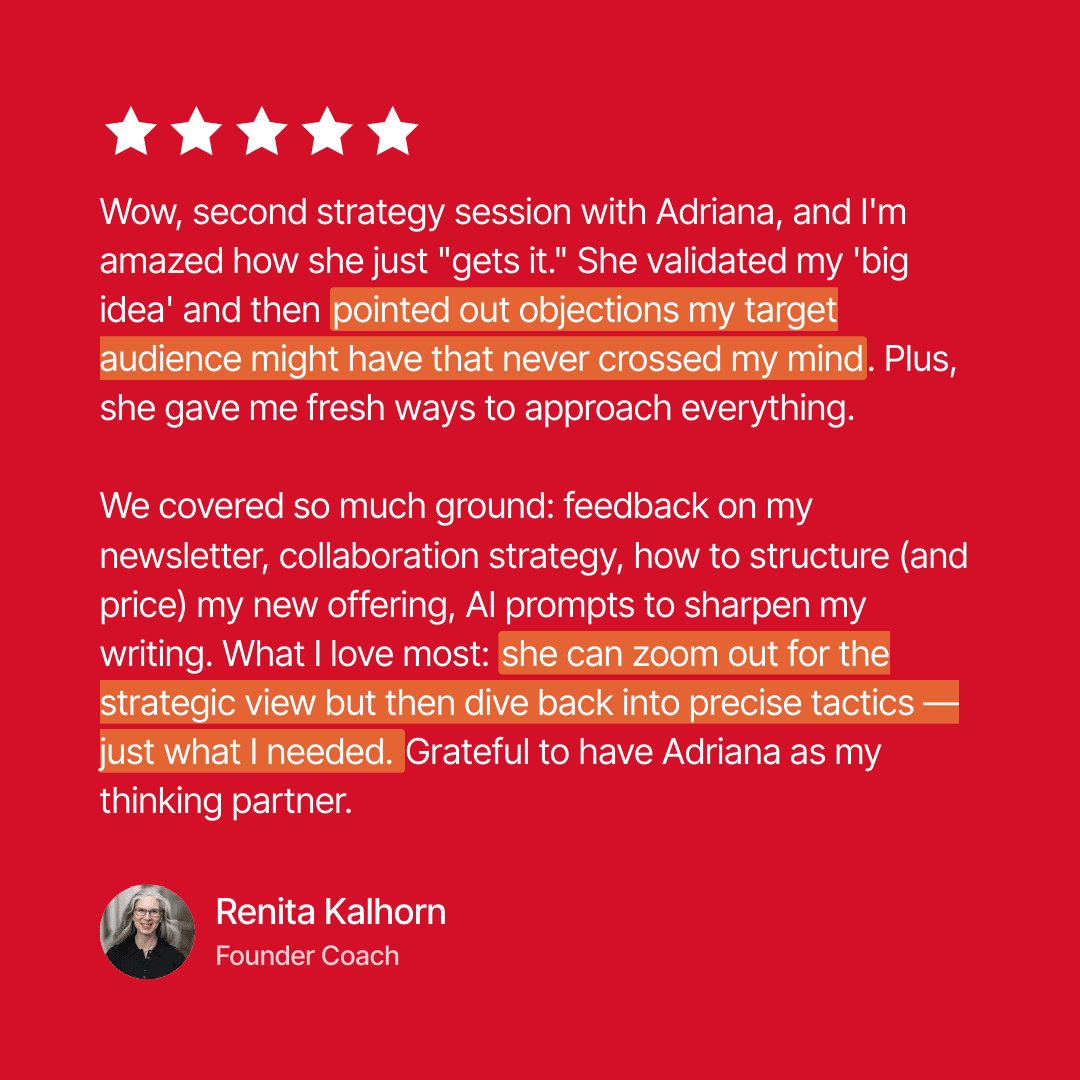
If you have a strategic decision you have reopened repeatedly—around your positioning, offers, audience, business model, marketing priorities, or what deserves your attention next—bring it to a strategy session.
We’ll examine the evidence, expose the trade-offs, understand what’s possible vs what’s probable, and close the decision with a direction you can execute on.
Because your business already has enough work; it can stop paying interest on the same fucking question.
Here’s what’s possible in a strategy session: