
Why is online content so damn bland, unimaginative, and overall bad?
In most online bubbles, AI is the culprit. Heck, there’s even a word for AI over-reliance now.
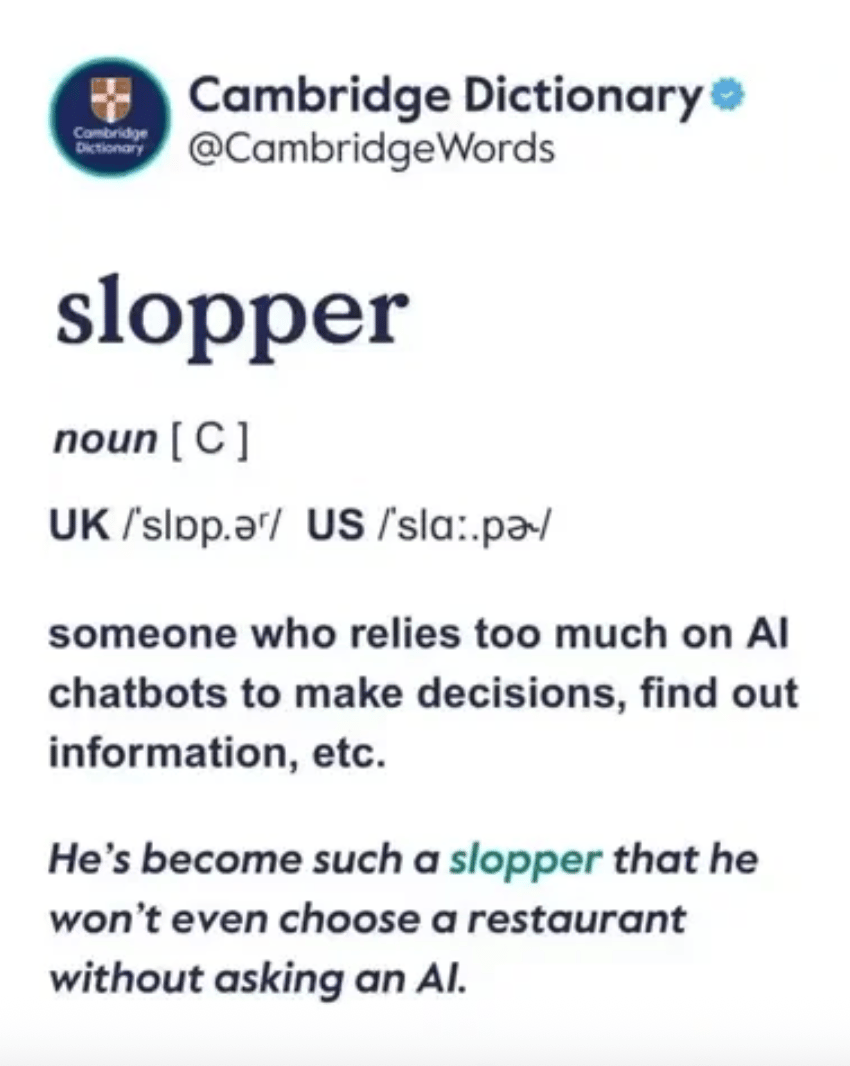
And yet, I think AI is the scapegoat rather than the actual culprit.
Five years ago, people blamed content farms (“SEOs ruined search” is a commonly cited reason — it’s not wrong either). Today, they blame AI.
In another five years, they’ll blame whatever comes next.
It’s a comforting story because it gives us a villain, and villains are tidy. They make us feel like someone else caused the problem.
Unfortunately, the Internet doesn’t work that way. In fact, neither does the world overall — AI is not the thing that created slop, just as our generation isn’t the first one to produce bad content.
We just tend to romanticize the past. So let’s be honest about it for a change, shall we?
Every technological leap in publishing has produced exactly the same reaction. The printing press, invented around 1440 (!), flooded Europe (and then the rest of the world) with books. Most weren’t masterpieces.
The blog boom gave us millions of articles optimized for Google instead of humans.
Then social media rewarded volume.
Then content calendars rewarded consistency.
Now AI rewards speed and, again, volume.
Do you see a pattern here? The technology changes, but the incentives stay the same throughout the centuries.
People will always, always choose the easy way to produce content (or anything else, for that matter), whether that’s printing hundreds of copies of bad books or churning out hundreds of social media posts with AI.
So yeah, people like to romanticize some imaginary past when every article was handcrafted by monks in candlelit monasteries. But did you read those? Are you sure that, just because it took longer to create something, it was automatically better?
We’ve always produced enormous amounts of mediocre content. The difference is that mediocre content used to be expensive.
Today it costs almost nothing. That’s the only thing that has changed.
The same goes for courses. The world is filled with bad business courses, and that was true before AI. If you sell a course, can you tell if it’s good or bad? If it’s what your buyers expect?
📣 Brought to you by 📣
The State of Courses in Business Report
Buyers already know your course might suck.
My friend Catrina Mitchum, PhD, surveyed 22 business owners and interviewed three. Course buyers, course sellers, and “I’m planning on it” folks all jumped in.
And half the sellers can’t tell you if their own course works, because they never measured. Every buyer in the room has caught on, and they’re done paying for garbage. What they want instead points straight at the fix.
Dig into more data and optimize your own course:
Want your name up here? Reserve your slot! (Sold out until September)
When something becomes cheaper to produce, you never get more quality. You just get more supply.
Again, this isn’t just about content. It’s econ 101, something we’ve known for centuries: when the cost of production falls, output explodes, and average quality declines because barriers to entry disappear.
Whenever I hear someone say, “AI is ruining content,” I mentally replace the sentence with my take on what actually happened:
People finally have enough leverage to optimize for the wrong thing
Back in my agency days, I constantly refused clients who had no other demand than volume: “We need 10 blog posts per month; neah, make it 20!” or “We need to post on socials at least 5 times per week.”
Very few of these people had a good answer when I asked them “Why? Why do you need so many blog posts? Why are you hoping 5 social media posts per week will fix your lead generation?”
Make no mistake, the people who had the means to produce near-infinite amounts of content in the pre-AI era did it. And yes, that was slop too, just not the AI kind.
The clients I refused found a content farm that happily took their money and didn’t ask uncomfortable questions (yes, I checked).
All this to say that AI is not responsible for the inane amounts of slop we see online because its role is to faithfully amplify whatever system you build.
→ A thoughtful strategy becomes faster.
→ A terrible strategy becomes louder.
The obvious question is: how do you avoid becoming part of the slop?
The answer isn’t “don’t use AI.” That’s lazy and a bit like saying the solution to bad photography is to ban digital cameras and return to film cameras.
Use or don’t use AI, as you wish.
Just ask yourself this: what are you optimizing for?
Most people optimize for output because output is measurable. It’s easy to count posts, newsletters, videos, impressions, and clicks. It’s much harder to measure whether your thinking improved, whether your audience understood something they didn’t yesterday, or whether your content changed anyone’s mind.
The tragedy is that these are precisely the things that create demand over the long term.
Whenever I review someone’s content, I almost never think, “This person needs to publish more.” I usually think, “This person needs another hour with their audience.”
That hour is where the interesting questions appear, where the obvious take gets challenged, where you remember the client conversation from six months ago that perfectly illustrates your point, where you notice that everyone in your industry keeps repeating the same assumption without ever examining whether it’s true.
None of those things happen because you asked ChatGPT for “10 LinkedIn posts about leadership.”
Ironically, AI becomes much more useful after you’ve done the difficult thinking. Once you’ve developed an original perspective, AI is fantastic at helping you expand it, pressure-test it, adapt it to different platforms, find missing angles, and turn one idea into ten. In other words, it accelerates thinking that already exists.
Most of the advice around AI gets the order backwards
People ask AI what they should say before they’ve decided what they believe, so they outsource the very part of the process that makes their content worth reading.
That’s a recipe for producing statistically average ideas because that’s exactly what large language models are trained to generate: the most probable continuation of a sentence.
Candidly, this was the hardest part of turning my methodology into an AI-powered app: getting the AI to stop defaulting to its average database and only pull information from my own materials.
I built The Profitable Content Engine program as the most affordable way to teach you my methodology that gets you authority and revenue. The AI is there for personalization ONLY, to understand your business, your goals, and your constraints and build lessons and assets around those.
BUT without defaulting to basicness (as much as you can keep an AI in check).
Wanna try it? You have a 7-day money-back guarantee, so what do you have to lose?
So, how do you stay away from the most probable (and bland) continuation of a sentence?
Try flipping your workflow
Before you write a single word, ask a question.
- What pattern have you noticed that other people haven’t?
- What opinion would you still hold if LinkedIn removed the like button tomorrow?
- What belief in your industry feels increasingly wrong?
- What mistake do clients repeatedly make before they hire you?
- What do your prospects need to hear in order to buy from you? ← my personal favorite
Those are strategic questions whose answers tend to be far more durable than “What’s a good hook for this week?“
Then start measuring your content by utility instead of activity
One of the questions I ask my consulting clients most frequently is “why did you publish this?”. My goal is to figure out the thinking behind every single piece of content and to help my clients ALWAYS tie what they publish to their business goals.
A post that gets five people to rethink a buying decision is infinitely more valuable than five posts that collect polite engagement before disappearing into the feed forever.
To me, content is intellectual property, so it should always have a goal. Typically, everything you publish falls into one of these four goal buckets:
- Lead generation content (small asks, like “download a lead magnet”)
- Direct monetization content (big asks, like “buy this now”)
- Authority building content (your [controversial] takes, methodology, and more)
- Entertainment content
Together, these shape the full picture of your brand — what people know about you, why they trust you, and why they (will) buy from you.
That’s one of the reasons I built the Profitable Content Engine the way I did. I had no interest in creating another AI tool that spits out 328 content ideas before breakfast; the internet has enough of those already.
Instead, I wanted something that behaves more like a strategic advisor than a vending machine. Every day, it nudges you toward the next decision that actually matters, teaches one principle behind it, and gives you one practical exercise to sharpen your thinking before you create anything. TBH, it’s more strategy than content.
Because that’s ultimately what separates signal from slop.
The people who’ll thrive over the next decade will be the ones who learn to generate the most insight—and then use AI to distribute that insight more efficiently than ever before.
Technology changes; social media platforms change too, just like fashion trends. The incentives that humans respond to, however, stay the same.
Think about it this way:
- The people who optimize for volume put their energy into finding faster ways to produce more volume.
- The people who optimize for thinking put their energy into finding better ways to spread better ideas.
I think you can guess which side of history I want to be on. It’s not necessarily the “best” choice — just the one that aligns better with me. You can find success with either of these approaches, just like I told you last week about personal vs expert brands.
What’s YOUR choice?
The Council Bulletin
In The Council, we’re using the slow summer to set foundations for the fall. Like Glen, who got sh!t done quickly:
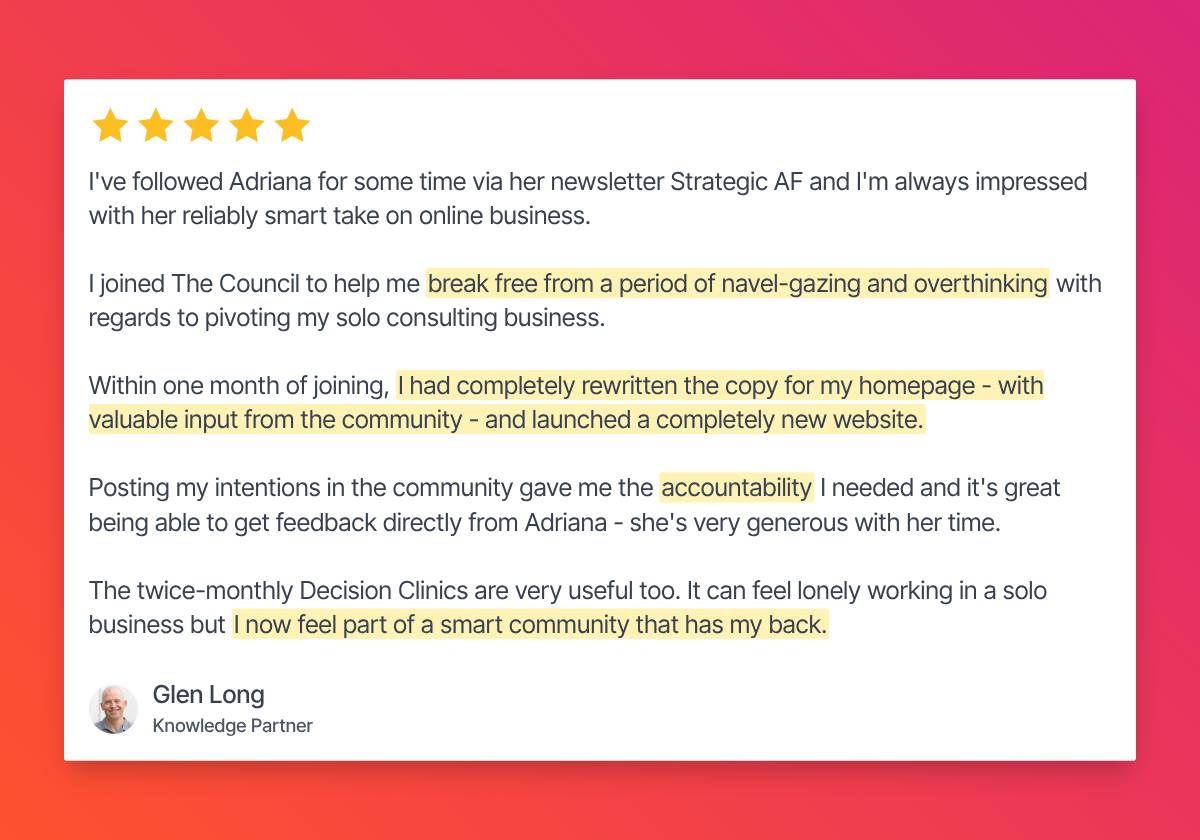
Wanna join us? We don’t have cookies, but we do have exciting projects and ultra-smart, helpful members!