
“I need to prepare my exit. I always knew this business wouldn’t last forever because personal brands have a shelf life.”
— I heard a variation of this statement from three different and very popular people in a similar niche to me recently. And it gave me pause.
OK, first off, it gave me anxiety — do I need to do the same? How close am I to the end of my business’s shelf life? Is it closer or farther than these super accomplished people?!
Yep, I panicked. I started thinking about all the people I used to know on LinkedIn, for instance, and who have disappeared throughout the years.
And there’s plenty of evidence to support a panic attack. I’m sure you’ve seen it too: someone explodes seemingly overnight, dominates your feed for a year or two, then fades away as the algorithm discovers someone younger, louder, or simply different.
Every platform has its own graveyard of former internet celebrities. Vine produced dozens of creators who once felt impossible to ignore. Today, most people would struggle to remember their names (can you?). The same happened to countless meme accounts, motivational influencers, and “growth hackers” who built enormous audiences around being the exciting new thing.
Once I took a deep breath, I realized that my panic attack isn’t warranted, though. And, perhaps, some of the people who said they needed to find a new thing shouldn’t plan their own fall from grace (unless they’re tired of their current business, of course).
I postponed my panic attack by thinking of two very popular “personal brands”: Esther Perel and Mr. Beast.
Esther Perel has never dominated the online world the way Mr. Beast has.
I’ll tell you more about that and the psychology behind it after I introduce you to my way of helping you build an expert brand, NOT a pure-bred personal brand.
📣 Brought to you by 📣
The Profitable Content Engine — The App
The Profitable Content Engine won’t teach you the formats and hooks that are trending on social media this week. It will teach you how to create authoritative content, the kind that outlives For You feeds and fads, and the kind that gets you paid.
On July 28th, I’m launching it in a hyper-personalized format that takes your niche, your time constraints, and your monetary goals into account and builds a learning and implementation experience designed to position you as a profitable expert, not an influencer.
Want in? Join the waitlist to get the official announcement — and the time-sensitive launch discount!
Want your name up here? Reserve your slot! (Sold out until September)
I think the people who say that personal brands eventually die are observing a real phenomenon and drawing the wrong conclusion because they’re treating every personal brand as though it’s the same business.
It isn’t.
Some personal brands are built on attention; others are built on expertise.
Those two assets age very differently, and the reason has less to do with marketing than with how the human brain works.
The psychological and neurological explanation for personal brands fading away
We’ve known for decades that our attention system is strongly biased toward novelty. Throughout our evolutionary history, new things deserved attention because they could represent danger, opportunity, or useful information.
For instance, an unfamiliar sound in the bushes mattered more than the thousand familiar sounds you’d already heard that day. That preference didn’t disappear once we invented smartphones. Social media simply discovered how to monetize it.
In fact, “when a stimulus is repeated, the neuronal response to it (in many parts of the brain) often decreases rapidly. The response is highest when the stimulus is novel.” [source]
Neuroscientists have found that novel stimuli activate dopaminergic pathways involved in learning and reward prediction. Contrary to popular belief, dopamine isn’t simply the “pleasure chemical.” One of its key functions is helping us notice unexpected information and update our mental models. Novelty captures our attention because unexpected events may contain information worth learning from.
Once you understand that, the rise and fall of internet celebrities becomes far less mysterious.
If your primary product is novelty, you’re signing an unwinnable contract
Today’s surprise inevitably becomes tomorrow’s routine. And no, the audience didn’t betray you. Their brains simply stopped receiving the same neurological reward from seeing you for the hundredth time.
Personal example: as a marketer, I follow Seth Godin and subscribe to his newsletter (I’m sure most of my peers do). Yet, it’s been months since I opened one of his emails or seen his face on social media.
I never stopped appreciating his thinking. I simply got busy with other things and my social media feeds decided to show me something else. However, if he were to launch a new book, I’d buy it in an instant.
Speaking of, Seth Godin published Permission Marketing in 1999. Esther Perel has been talking about relationships for more than twenty years. Simon Sinek’s TED Talk peaked well over a decade ago. Tim Ferriss published The 4-Hour Workweek in 2007. Morgan Housel wrote The Psychology of Money in 2020, building on years of financial journalism before that.
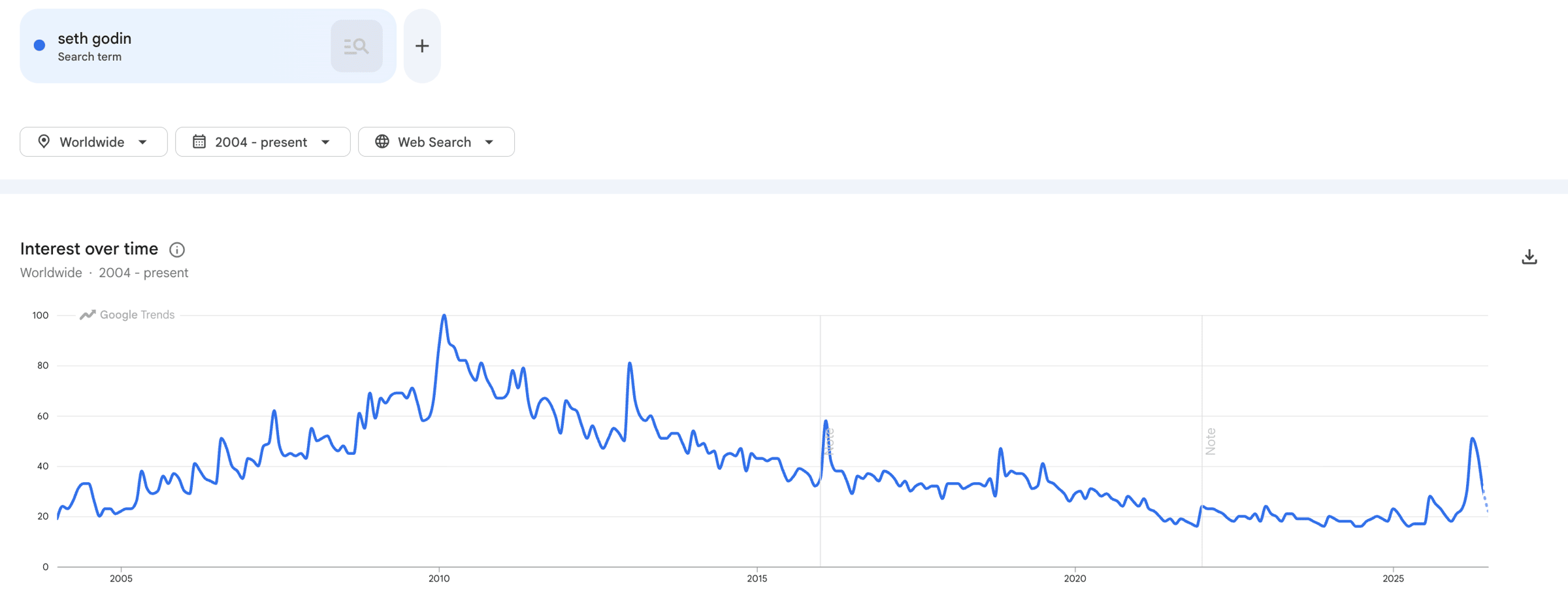
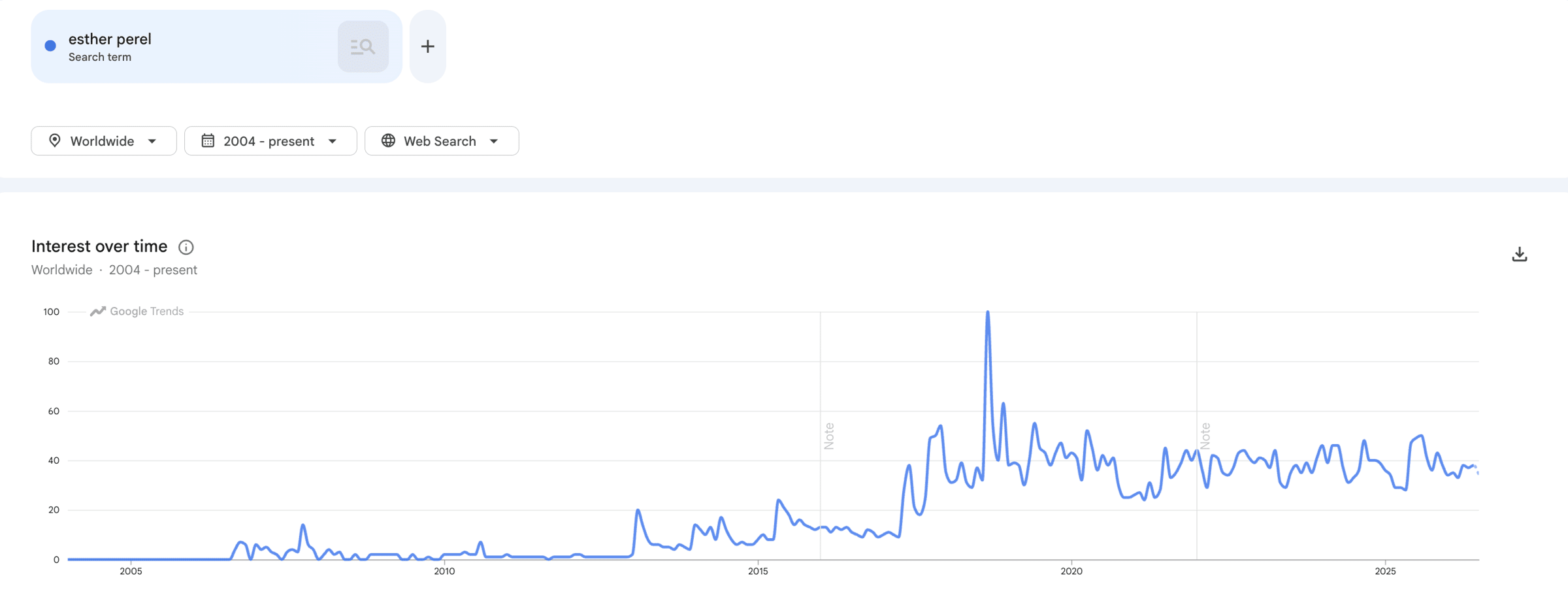
None of these people dominate social media in the way a Mr. Beast video does. None of them own the cultural conversation every week. If you look them up on Google Trends, you’ll notice something interesting.
Their search volume declines after major launches, books, or viral moments BUT it never reaches zero.
Don’t worry; I did these searches for you.
Seth Godin:
Esther Perel:
Tim Ferriss:
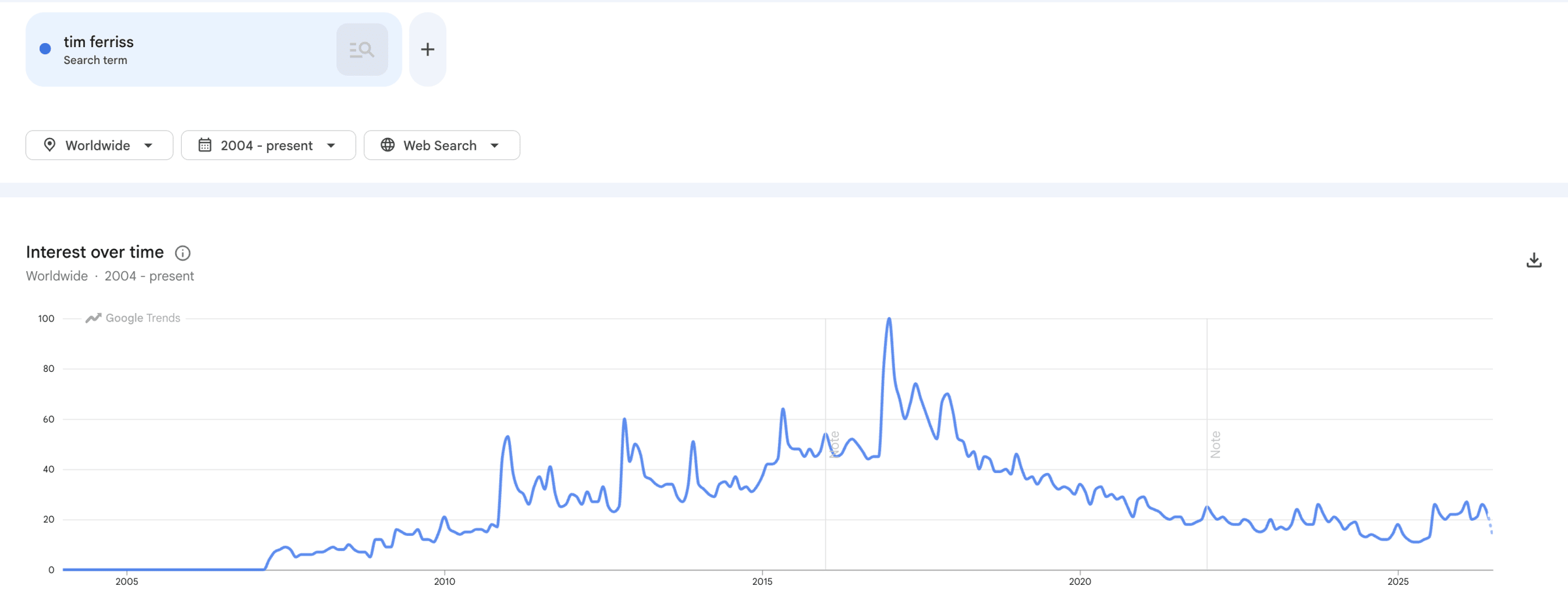
See how these graphs look less like a rocket launch and more like a mountain range? The audience may become smaller over time, but it also becomes remarkably durable.
The same thing happens outside the internet.
Metallica released Master of Puppets in 1986 and The Black Album in 1991. They are no longer the newest band on Spotify, yet nearly forty years later they continue selling out stadium tours around the world. The Rolling Stones have been doing the same thing for decades. Their audience has aged alongside them, and younger listeners continue discovering them through an ever-growing catalogue of work.
Nobody buys a Metallica ticket because the band is trending on TikTok that week. People buy because decades of consistent output created trust.
That’s an authority asset.
There’s another category of public figures that illustrates the opposite effect.
Think about names like Chewbacca Mom, the “Damn Daniel” teenagers, or many of the creators who became household names during Vine’s brief existence. Their popularity was real, and their audiences were enormous.
But their careers depended on continuing to generate surprise, humour or spectacle at a pace few human beings can sustain indefinitely.
Here’s what Chewbacca Mom’s graph looks like:
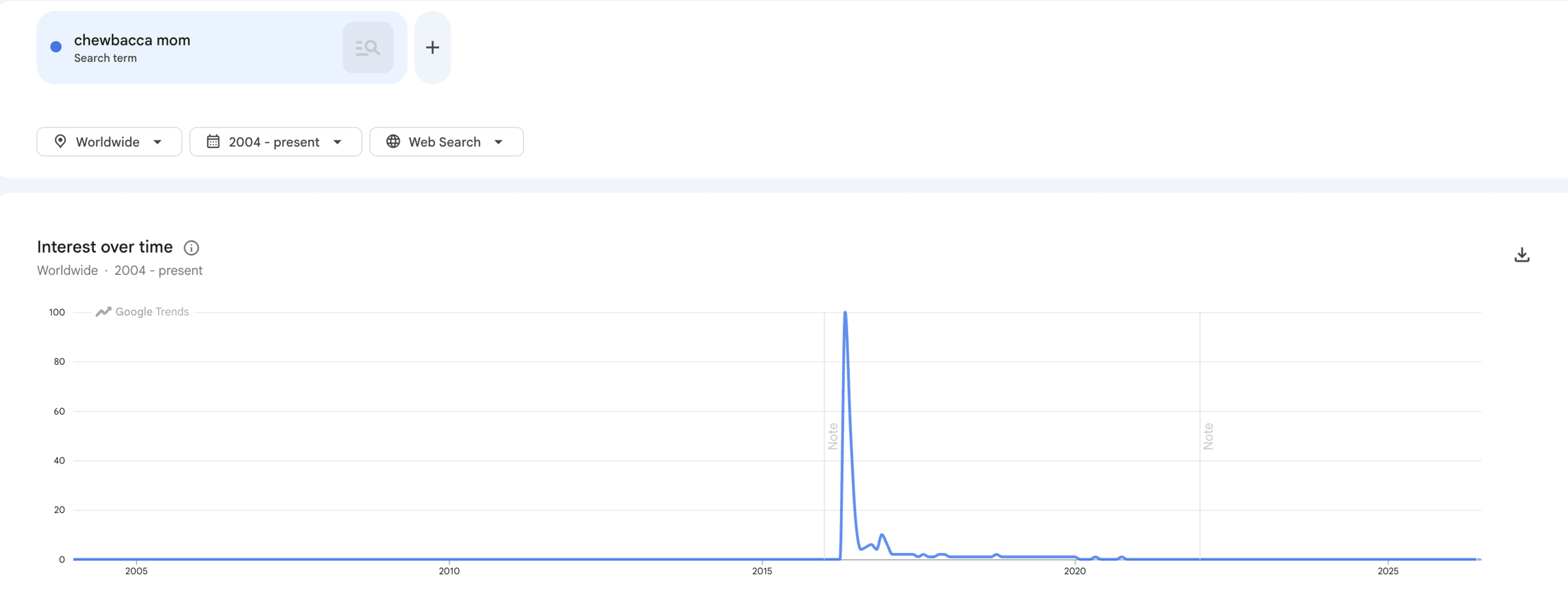
Again, this isn’t criticism. It’s the economic reality of attention-based businesses.
Many of the people who started as attention-dependent personal brands capitalized on that and went on to build other businesses; they’re not as active on social media as they used to be because they don’t need it.
Mr. Beast is a good example here. To some extent, so is Gary Vaynerchuk — although he’s still active online, he’s less relevant, BUT he’s not relying on attention alone anymore.
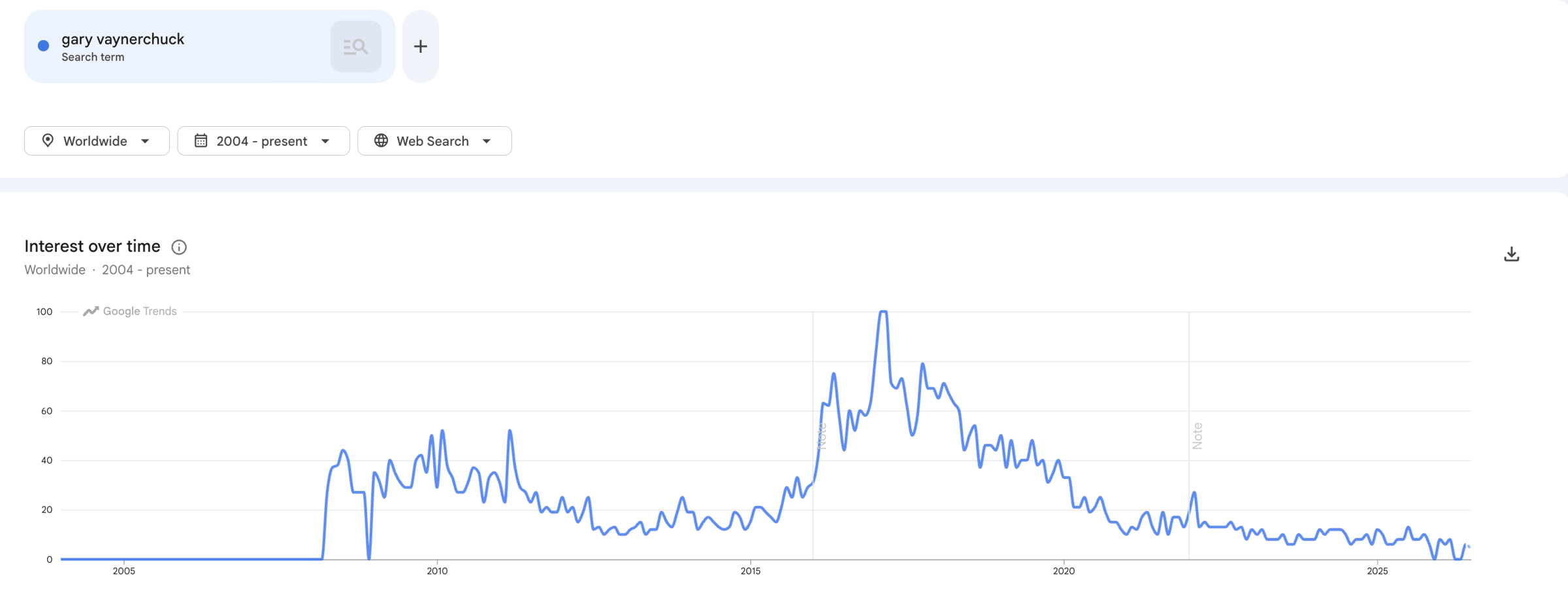
There’s absolutely nothing wrong with this model
The problem starts when experts copy that model. Every week I see consultants, coaches, and bona fide experts worrying that they aren’t “blowing up”, as though the correct benchmark for a pricing strategist is someone whose job description involves spending $10 million recreating Squid Game on YouTube.
Those are different games:
- One optimizes for attention — the other for accumulated trust.
- One treats every post as a fresh audition — the other as another brick in a body of work.
That’s why I think “build a personal brand” has become one of the least useful pieces of business advice on the internet: it hides the only distinction that matters.
What are you asking your audience to remember you for?
Your jokes? Your lifestyle? Your production budget?
Or your thinking?
Experts should absolutely care about attention. Attention is how people discover your work in the first place. I’ve written before that attention isn’t optional; it’s the entry ticket. But for an expert, attention is only valuable if it leads somewhere durable.
Otherwise you’re renting visibility every single day.
Authority works differently — it compounds. [Read more about the force of compounding in The Resonance Principle, my manifesto.]
Every thoughtful article reinforces the previous one. Every client success story strengthens your reputation. Every framework gives people another reason to associate your name with a particular idea.
The individual pieces of content may disappear into the algorithm after a few days, but together they create something far more valuable than any single viral post.
They create memory.
That’s why I’m completely disinterested in helping experts produce content with the shelf life of a fruit fly.
There are already dozens of AI tools optimized for that. Heck, you can use any chatbot for it.
I’m interested in something much harder: helping experts notice the ideas they’ve stopped noticing, develop them into intellectual property, and build authority that continues paying dividends long after the algorithm has moved on to the next shiny object.
Because trends inevitably expire. A body of work rarely does.
This is the core idea behind The Profitable Content Engine: become known for your work and create content that gets you paid for it too. Join the VIP list to be the first to know when it drops.
Do you hate the term personal brand?
My friend Bryan does — and so do many people I know. I’m ambivalent: I understand it’s become a tired trope but, for now, it’s the best we have.
And, make no mistake, even expert brands have a personal component to them. It helps when you’re videogenic and charismatic — your ideas get through much more easily.
Dropping a quick personal story helps with relatability, for instance. Then again, I haven’t met anyone who appreciates Seth Godin because he’s relatable and seems like a cool guy — his appeal lies elsewhere.
Still, while the line between relatability and performative vulnerability is very blurry, not all of us can be Seth Godin.
I’ll leave you to ponder which game you want to play, knowing that there’s no right or wrong — you just have to make a choice.
Need me in your corner? Here’s how I can help you:
- Promote your brand to 30,000+ entrepreneurs and creators.
- Need a bigger, more relevant audience? Who doesn’t, right? The Audience Accelerator course will teach you how to get it with zero hacks and sleazy bro tactics.
- Grab the Strategic AF Welcome Sequence to delight and convert subscribers from the first emails. Plus my framework to personalize it through automation.
- Boost your chances of success by 400%: document your strategy with The Guided Strategy Template.
- Get my product launch email templates that sell: 5+1 emails you can send to your list in 45 seconds.
- Book a 1:1 strategy session with me. Let’s unlock your growth in 60 mins!