Have you ever felt overwhelmed by the countless options, opportunities, and channels at your disposal? I have yet to meet someone who hasn’t.
This comment from my friend and fellow Council member Lee Densmer made me realize I should write more about business advice.
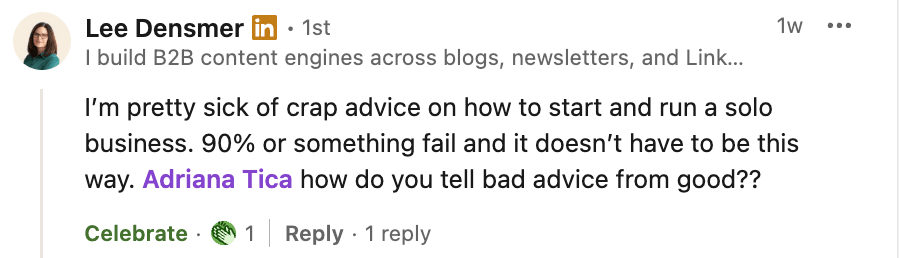
Because Lee is right: other than health, there is no other industry that’s plagued by as much crappy advice as business. And it sucks, especially if you’re a beginner and you don’t have your very own filter yet.
But, candidly, even we, seasoned business owners, occasionally fall for advice that’s so confident that it has to be right, RIGHT?!
So let’s talk about what Lee suggested: how can you tell good advice from bad advice?
First off, here’s the obvious advice about advice:
IGNORE all advice phrased like this: “The only way to outcome X is Y”
Right-click, delete, ignore forever — seriously! Business and marketing are not exact sciences, so there’s no single path to any outcome.
We’re swimming in advice from people who sincerely believe they’ve figured it out. Some grew on YouTube. Others swear by LinkedIn. Someone else built a fortune through cold email, partnerships, webinars, SEO, communities, podcasts, affiliates, Facebook ads, TikTok, or carrier pigeons.
Every one of them has data and case studies; and they all sound convincing.
Because they’re all describing what worked… in their situation.
Imagine a chef telling everyone the secret ingredient is saffron.
He’s right — if you’re making paella. He’s considerably less right if you’re baking brownies.
Yet this is exactly how marketing advice gets packaged. Someone discovers one ingredient that worked in one recipe, then sells it as universal truth.
Really?
Human beings have been buying things for thousands of years. Millions (billions?) of businesses have existed. Entire industries have grown using completely different strategies.
But this person cracked the one universal formula and is willing to share it with you during a free workshop. How convenient.
If you see this kind of advice, know this: the person selling it only knows how to do one thing, and they’ve probably never worked with enough clients to understand its limitations (because every tactic has them.)
Speaking of single-ingredient advice, let me introduce you to my friend Stephanie Kruse, who does the exact opposite of that. Stefanie talks about websites for solopreneurs without “one-tweak formulas to increase your conversion rate to 600%”.
If you’re tired of crap advice about websites and if you’re still unsure what to focus on and what to ignore, you need her sage, nuanced advice in your life.
📣 Brought to you by 📣
The Website Shift
If you’re a solopreneur whose website isn’t pulling its weight despite doing “all the right things,” The Website Shift finally explains why: most website advice is built for companies with teams, budgets, and a marketing department. Not for you.
Every Monday, Stefanie Kruse breaks down what actually makes solopreneur websites work. Not trends or tricks. Practical insight that makes your expertise visible, credible, and profitable.
Trust me, you won’t look at your website the same way again after reading what Stefanie has to say about it. And you’ll mute everyone who claims that you need ONE thing for unavoidable success.
Want your name up here? Reserve your slot! (Sold out until August)
Now let’s talk about the advice that’s not dead wrong, yet it might be wrong for you.
Every guru is right. For someone.
A few weeks ago, I stumbled across yet another post in the same vein I’m sure you’ve seen before: “I built a $100k/quarter business almost entirely through [Reddit].”
The comments looked exactly how you’d expect: “What’s your Reddit strategy?”, “What subreddits?”, “Can I pick your brain about it?”
Within 48 hours, I guarantee at least a handful of people had created a Reddit account, set up a posting/commenting schedule, and convinced themselves this was the missing piece.
Three months from now, most of them will conclude that Reddit doesn’t work and that the advice was bad.
I’m willing to bet that the advice itself was not bad; I’m sure that person did find success through Reddit.
But could someone else’s map lead to your destination?
Business advice has a context problem. Even if the adviser is not screaming “this is the ONLY way to get X”, you should still filter that advice.
Yes, the person sharing it usually has good intentions: they discovered something, and they want others to benefit from it too. But that doesn’t mean it’s right for everyone.
“I absolutely don’t want to do a newsletter”
–— One of my first strategy session clients to me, years ago. If you’ve ever done a strategy session with me, you know that I come prepared. I study the client’s assets and prepare answers based on the challenges they list in their intake form.
This client knew they needed to be on at least one more channel, but they didn’t know what to choose because, again, they were swimming in advice. Knowing that I’m very bullish on my newsletter and that Strategic AF is my best way to generate revenue, they assumed I’d push them to start one too, because that’s what everyone does: they try to replicate their own success story.
Yet, I had no intention of doing so. I already knew their strengths and weaknesses, so I recommended YouTube + an email list for sales only, not editorial content.
But that was in a strategy session, a personalized encounter. What happens when you see advice that’s shared with more than one person, like in a newsletter or on social media?
The next time you see advice that sounds good from someone you trust, should you take it?
The context test
Yep, we all want $100k quarters from a single channel. When you see impressive results from someone else, don’t jump straight to “How do I copy this?“
Ask these questions instead.
- How similar is my audience to theirs?
- Do we sell similar things?
- Do we have similar prices?
- Are we at a similar stage of business?
- Do we have similar strengths?
- Do we enjoy working the same way?
Because if the answer to most of those questions is “no,” you’re borrowing tactics from a completely different game. Admire those results from a distance and move on.
A B2B consultant selling $10,000 projects shouldn’t blindly copy a creator selling a $29 template. The same way someone with 500,000 YouTube subscribers plays by different rules than someone with a 2,000-person newsletter.
An extrovert who loves speaking will naturally build a different business than someone who’d rather wrestle a crocodile than attend another networking event.
See where I’m going with this?
So what advice should you listen to?
First off, personalized advice, not because it’s automatically smarter, but because it starts with your constraints instead of someone else’s success story.
Caveat: make sure your adviser has breadth and depth of knowledge. If they’re a one-trick pony, they’ll recommend the same playbook to everyone — not all 1:1 conversations are personalized.
The best strategy sessions I’ve ever had with clients rarely involve revealing some secret tactic they’d never heard of.
Most of the time, they already know the available options. You know them too: newsletter/email, podcasts, LinkedIn, Instagram, webinars, partnerships, YouTube, and so on.
The real work is figuring out which of those makes sense for their business.
That’s strategy.
This is why I’m willing to die on this hill: advice becomes valuable only after it’s filtered through your business.
The era of certainty and how it screwed us all
The internet rewards certainty:
→ “It depends” doesn’t go viral.
→ “Here’s the only way” does.
Certainty isn’t always correct; it’s just very marketable.
This is why experts often lag behind [full video explanation here]. They know nuance, edge cases, exceptions, and more. So they’ll never promise “this will 100% work for you. BUY NOW!”
Instead, we say things like “it works in most cases” or “if you already have X, you can get Y with my help.”
Listen, I know I’m shooting myself in the leg by emphasizing nuance. Every time I write about a platform, I talk about its limitations too. For instance, I wrote about Medium, Reddit, LinkedIn, and others, but I never said “the definitive playbook for platform X”. WTF is that? But also: I could have gotten viral far more often if I had done that.
Similarly, I could sell you any of my courses and tell you it will 100% work for you, but how the hell could I know that without knowing you? What I do know is that they’re not for everyone, which is why all my landing pages have a “do NOT buy this if…” section — to help you figure out if my products are what you need.
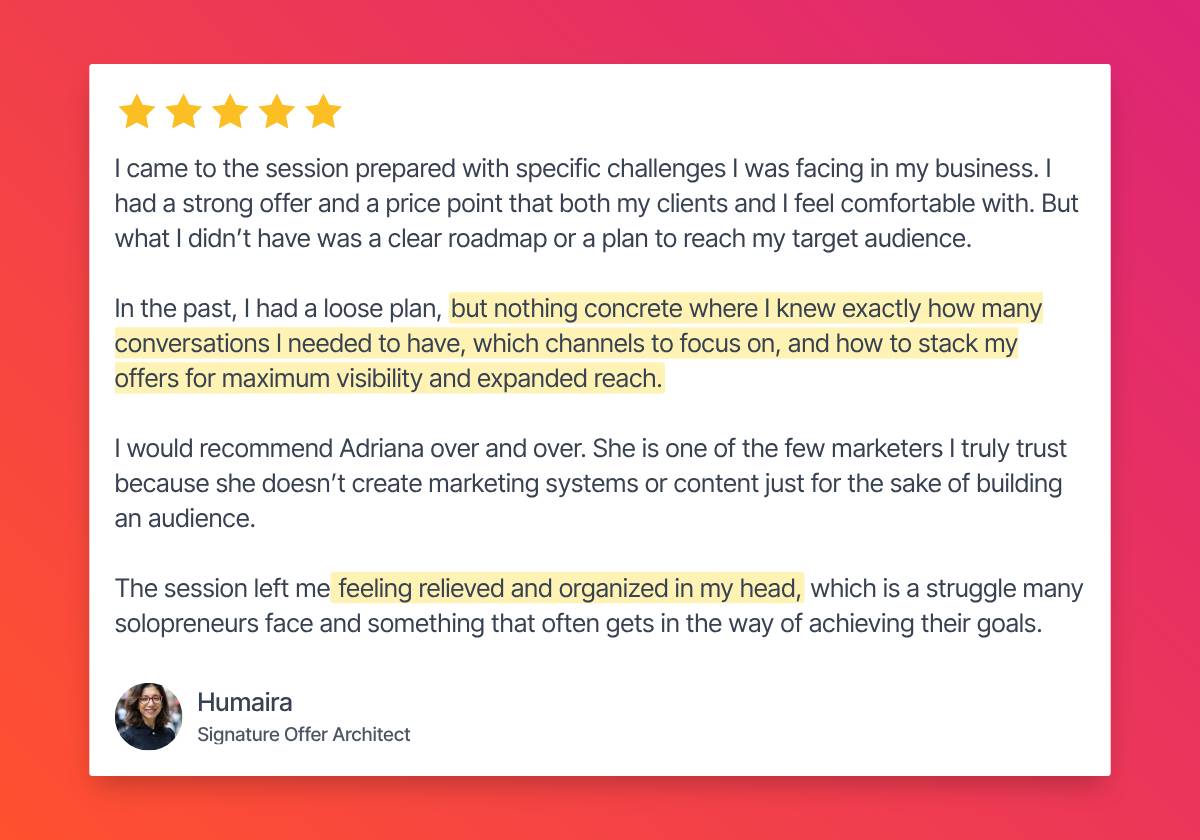
The only thing I know will help almost anyone is a strategy session because it’s highly personalized. Even so, I know I can’t make any monetary guarantees, like “buy it and 10x your revenue”. This is a sample of what a session with me CAN realistically do.