
Let me ask you this: Do you absolutely, 100% need to be an influencer to succeed online?
We recently had a debate about the big names of the online world in The Council. We spoke about over-indexing on the stuff we sell and presenting it as the only way to riches. Of course, the conversation moved to online presence in general.
This comment gave me pause, especially the part about the internet turning you into an influencer.
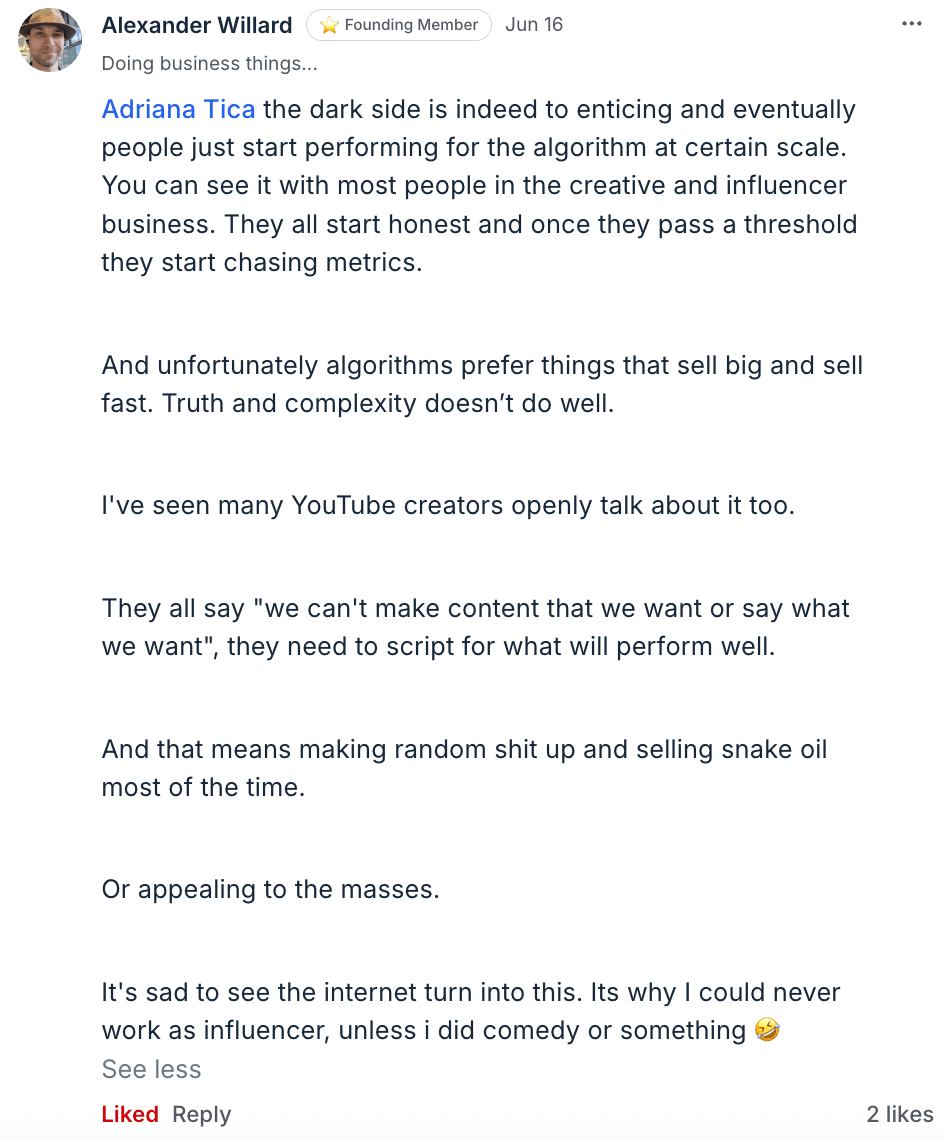
It’s something I’ve been thinking about for a while now because I see a lot of dissonance in this space. Let’s unpack it, but with honesty, not the usual posturing you see online.
Before we do that, let me introduce you to someone who influenced me to think differently about courses. Funnily enough, it’s because my friend Catrina Mitchum is not an influencer but a bona fide education expert.
You already know I think chasing passive income through courses is BS but that absolutely doesn’t mean that courses don’t have their place in some businesses.
What about yours? Should you build a course?
📣 Brought to you by 📣
Cut the Crap Newsletter
Should you build a course?
Everybody and their mother is telling you to “package your expertise!” “create passive income,” and “only work 4 hours a week!” with the solution being a course.
What they don’t tell you: a course isn’t always the answer.
If “should I build a course?” has been making your wheels spin, take the “Is a Course Right for YOUR business?” quiz.
Want your name up here? Reserve your slot! (Sold out until July)
“Influencer” is a derogatory term, so we shy away from it
What comes to mind when you say “influencer”? If I were to guess, it’s probably a person who makes money out of showcasing their lifestyle on social media.
We see these people as vapid and shallow, so we really, really want to position against them because we have substance and actual knowledge. However, I’d argue that any business that involves posting content online has a lot in common with influencers because:
- Influencers have a lot more business acumen than we give them credit for. You may see them as superficial mouthpieces for lifestyle brands, but there’s a lot of businessing behind any sponsored story of theirs.
- We all want to influence people. Maybe not in the same way, maybe not through parasocial relationships alone, but at least enough for people to buy from us.
The same goes for “content creator” or “internet personality”, or whatever other name we come up with for this type of business.
Personal story: back in 2022, when I was getting ready to launch this business, I was SO down — worse than I had ever been before. My business (the content marketing agency) was doing great, but I was decidedly not.
In fact, I was so burnt out and jaded that I considered taking a real job. Around that time, when I was debating whether or not to build the adrianatica.com website, I saw my name in the “Top 100 Content Marketing Influencers in the World” by Semrush.
To understand how bad a place I was in, you need to know that I opened that page only to see how many people in there I knew. I never ever expected to see my own name.
Worse yet, when I got to my picture, it took me a good few seconds to realize where I had seen that face before.
While I wasn’t crazy about the name “influencer”, that little mention pulled me out of the darkness and kept me going. Candidly, it took me days before I realized that I had just been associated with “influencer”. In the beginning, all I cared about was the fact that someone thought I was among the top 100 people in my industry world-fuckin-wide.
Influencer, creator, and business owner
Even though part of me making that list was my social media presence, like you, I’m sure, I have a love-hate relationship with social media. If business wouldn’t get much harder without it, I’d probably quit it.
Back in 2023, I stumbled upon a newsletter written by someone who swore off social media for business. I read it for a while (I can’t remember its name or the author’s name, sorry!) and then it disappeared, and I was genuinely sad.
Without ever having met this person, I was rooting for them – and for all of us, in a sense. I was holding on to hope that someone could build a lucrative business without social media.
In the meantime, the newsletter disappeared, and I heard on the grapevine that no, they couldn’t build a business with zero social media, so they gave up.
Of course, this is just one example. I know plenty of people who have a modest social media presence and yet thrive. Yes, you can build a business without it — except it’s much harder.
[Read more about non-social-media channels to consider.]
This is why I keep saying that, whether we like it or not, there’s an influencer/creator component in all our businesses.
No matter what you sell as a solopreneur, you will care about your reach because more eyes on your offers is always a good sign. Yes, we call reach and traffic “vanity metrics” in public and claim to be above those because we want depth and because “we only need two people to buy each month.”
Sure, but how do you find those two people? They will never be the first or only two people who see your offer. Your 1,000 true fans live among tens or hundreds of thousands of followers.
Because I promised you honesty, here’s what my business looks like from a vanity metrics perspective:
- Every time there was an uptick in web traffic, my business did better → I sold more products and services
- As my social media following grows, so do the opportunities I get, from speaking and partnerships to direct sales.
- Every time my audience grows, I get talked about in more rooms that I’m not in — and, even if not measurable, that’s the best kind of social proof there is.
So, are we all influencers or content creators?
Not really, no. The part I disagree with from the comment at the beginning of this essay is the fact that the internet will turn you into an influencer, no matter what.
To me, the line between the two is how much of your personal life you NEED to share online for your business to thrive.
I’m not talking about choosing to share more because you genuinely enjoy it; I’m talking about performative vulnerability as the only way to move the needle. If you read my manifesto, you know that one of the people I talk about in there is Esther Perel.
Now, she has a huge social media presence, and she (and her team, of course) continue to feed multiple algorithms every day. Would you say she’s a pure-breed influencer, though?
I wouldn’t. I’d say she’s an expert who happens to be the most influential voice in her space.
How do you balance things out, though?
One of the reasons real experts struggle online is that, because of sheer volume and recency bias, influencers in similar spaces do better. [Watch the full video here.]
At the same time, most experts I know refuse to play algorithm roulette or do silly dances on TikTok. They take their trade seriously, and playing around with influencer tactics feels like a betrayal to them. (OK, to us; I’m “them” too.)
This is why one of the things we do in The Council is figure out ways for visibility and expertise to co-exist in our businesses. No one in The Council is an influencer (or wants to be), but we all know we need visibility.
Visibility as an expert, not an entertainer, is, to me, one of the biggest challenges of our industry these days.
Getting the right visibility is, of course, more nuanced. However, for the sake of this essay, let’s just talk about the influencer elements all solopreneur brands need:
- A distinct voice of your own. A set of (BIG) ideas and a writing/speaking style that people can associate with you without needing to see your face.
- Constant presence in front of your audience. The Recency Bias is very, very real – people tend to buy from people they remember. If you disappear from the internet for months on end, odds are a big chunk of your audience will forget you and move on.
- Being part of (online) communities of peers. This is one of those things we rarely see in influencers’ lives, but they are all part of communities, and they support each other. No one can do everything alone.
I’m willing to bet you knew about all three of those things before you read them here — but maybe you never considered them “influencer” stuff. And yet, they are — before solopreneurs, it was influencers (starting with mommy bloggers) who did all of them and more to build solid online businesses.
The biggest difference I see:
- An influencer needs to build parasocial relationships first and real, bi-directional relationships second
- An expert needs to build eal, bi-directional relationships first and parasocial ones second.
This shapes how you show up online, too: less trauma pr0n, more showcasing your expertise. Less “I love you all” more “here’s how I can help”.
In both cases, visibility is needed, though.
Don’t let terminology kill your business
One of the hardest things I did in a strategy session recently was to convince someone they needed to be on Instagram, too. My client is a world-class expert serving B2C clients, and they were wondering why LinkedIn (the “serious” network for real experts) doesn’t work for them.
I immediately saw that Instagram was the better bet for them; yet, my client told me they hated the shallowness of that platform. My biggest accomplishment was showing them that they didn’t need to be shallow. They can be a serious expert on Instagram, too, even if it’s usually labeled “a place for influencers”.
Consider this: where does your audience hang out? And are you avoiding that place because you think it’s for influencers, not experts?
Don’t do yourself the disservice of letting labels dictate your business strategy.
Be honest: do you get the ick at the thought you might be labeled “influencer” and yet know that you can borrow some visibility tactics from that industry? Reply and let me know – I’m SO curious.