As you probably know, I spend most of my time talking to solopreneurs. Some of them make $20,000 a year. Some make $200,000. A few make considerably more.
There are a lot of factors that account for the differences in revenue (as you may have seen in the State of Solopreneurship report). However, there’s one thing that does absolutely nothing that accounts for this difference: information.
I’ve recently started looking through my strategy sessions notes and Council chatter. I realized that the person making $200k usually knows what a newsletter is. They also know about webinars, lead magnets, communities, content marketing, partnerships, positioning, referrals, and increasingly, AI.
The person making $20k knows all those things, too. Sometimes, in even greater detail.
Over the past few years, the internet has become extraordinarily good at distributing tactics. For every question you may have, you’ll find at least a dozen YouTube videos attached that (claim to) answer it.
Every challenge has a framework, a checklist, a prompt, a template, or a LinkedIn carousel promising to solve it in six easy steps.
If you want to learn how to write better emails, launch a course, build a community, create content, host webinars, grow on LinkedIn, or start a YouTube channel, you’ll find enough advice within ten minutes to keep you busy until retirement.
Knowledge is no longer scarce. Clarity is.
And I think that’s creating a problem that most people don’t recognize.
Speaking of clarity, are you clear on what your website could be doing better? If not, today’s partner will help you figure out what you can improve — in less than 2 minutes!
📣 Brought to you by 📣
SheDevelops
Your website looks fine but…why don’t they book?
My friend Magda built a free AI scanner to solve this exact problem. Drop your URL, and in 90 seconds, you’ll get a clarity score (1–10) plus a breakdown of what’s actually stopping warm leads from becoming clients. It’s for coaches, retreat leaders, and solopreneurs who charge premium prices but whose websites don’t show it.
Side note: I jumped at this chance myself and the results were…revealing to say the least. I’ve got a lot of work to do!
Want your name up here? Reserve your slot! (Sold out until July)
The average solopreneur today has access to more business information than most Fortune 500 executives had twenty years ago. Yet (or precisely because of it) many feel increasingly overwhelmed, scattered, and uncertain about what to do next.
Along with analysis paralysis, having too many options gave us The Paradox of Choice — as the number of choices we can (and have to) make grows, we also grow increasingly dissatisfied.
I have yet to go through a strategy session where I don’t get asked “should I use social media platform A or B? Sell X or Y?”
Candidly, I’ve been asking myself these questions way too frequently, too. We all have the same problem: we’re collecting answers before we’ve identified the question.
Most solopreneur businesses I come in contact with have:
- A newsletter
- A podcast
- A YouTube channel
- A lead magnet
- A course
- A membership
- A presence on 1-3 social media platform(s)
- Different offers (usually, at least 3)
This happens at every stage, save for beginners in their first year in business — we’re all hoarders of tactics and channels. Sometimes, this works splendidly.
Other times, though, my job is to help people simplify their stack and remind them that they don’t have to be everywhere and sell everything.
This is what I call strategy
If I were to find a synonym for strategy, that would be coherence. Every solopreneur swears by a different tactic or channel (here’s what 8 Council members swear by for client acquisition) because it makes sense for them.
Every individual piece makes sense on its own. The problem emerges when you can’t explain why all those pieces exist together — and this is where strategy work comes into play.
Beyond choosing tactics, strategy is identifying the critical challenge and concentrating resources where they will have the greatest impact.
[Read more about strategy vs tactics and how to create a strategy from scratch.]
In The Council, we have bi-weekly Q&A-style calls that I chose to name “Decision Clinics” precisely because they’re not about more information or deciding whether Instagram is better than TikTok or cohort programs are better than 1:1 work.
None of these is better than the other because they don’t exist in a void. So, during Decision Clinics, we help with analysis paralysis — every Council member knows the basics of most platforms and the mechanics of offers and pricing.
Getting feedback from peers who have been there, though, is entirely different — and helpful, for a change.
Marketing advice vs strategy advice
Yep, there’s a difference. Marketing advice is something you can easily find online, and it’s usually along these lines:
- YouTube is the hottest thing for solopreneurs right now (bonus: ”Here’s how to start a channel”).
- All solopreneurs need an email list.
- Here’s what the LinkedIn algorithm loves right now.
- You should be on at least three channels, and one of them should be owned.
- You should repurpose your content across channels.
It’s all very tactical, true, and very much needed. Tactical advice will always have its place.
The trouble with it is that people start with tactics before they have a strategy. Here’s what strategic advice looks like:
- For you, specifically, LinkedIn makes more sense than YouTube.
- Start with Threads, not Instagram.
- Focus on increasing your email conversion rate before you focus on list growth.
- Repurpose your YouTube content to Instagram reels.
See how none of these things is blanket advice and how they can’t all be true for the same business?
That’s the whole thing: your strategy should inform the tactics you prioritize, not the other way around.
The internet, even AI, is great at teaching solopreneurs how to do things. Strategy helps people decide what deserves doing.
You know how to do [X], but should you do it? Well, it depends
I know, “it depends” is the world’s most hated advice. But, if you don’t leave things there and explain what it depends on, it’s also the most valuable.
It’s the kind of advice that separates experts from grifters (yet, it doesn’t always work in our favor — I explained why here).
The best strategists I know aren’t walking encyclopedias of tactics. They don’t know every platform, every algorithm update, every AI tool, or every growth hack.
What they do exceptionally well is decide what matters.
In a world where information is becoming infinite, that ability becomes increasingly valuable, which is why I think the future belongs less to people who know the most and more to people who can focus (on) the best.
I’m willing to bet you don’t need more tactics
You need to know which to focus on and which to nix. For instance, if you’ve been thinking about jumping on a new channel, consider this:
- Do you have the bandwidth to allocate to it? Consider how many hours per week you need to invest in it.
- If not, is there another tactic that has meh results right now and that you could drop to make room for the new channel?
- Why do you want to be on a new channel? This is the most important question because the answer needs to be coherent with your existing strategy. If it’s not, ignore it, no matter how many people swear by it.
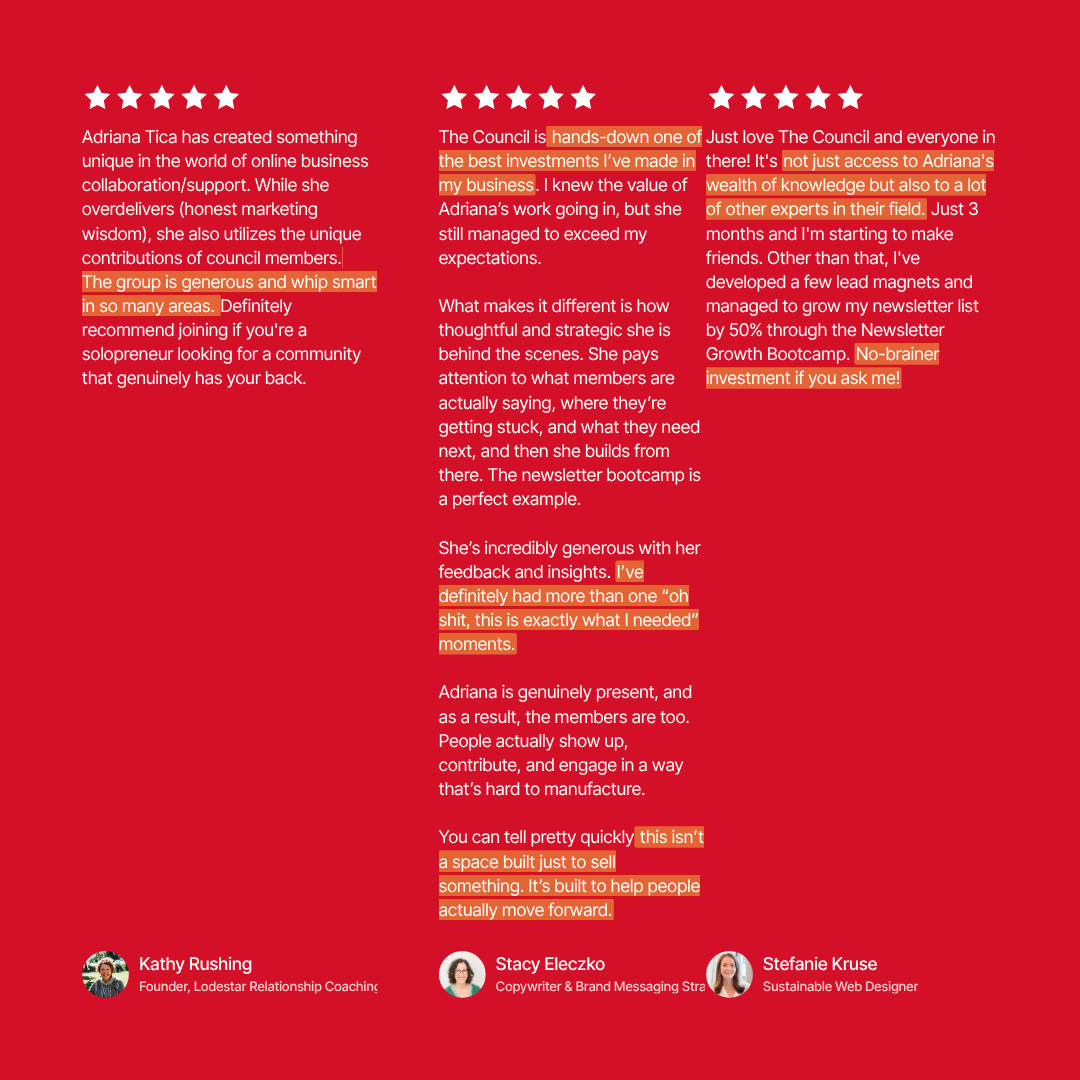
This is exactly the kind of strategic advice you have access to on demand in The Council. Not sure if it’s right for you? I’ll show you how current members see it below — reply to this email, and I’ll answer any questions you may have. Or join us here.