One of the weirdest things that happened to pricing advice over the past decade is that, even though economists spent centuries studying how markets work and creating detailed explanations of demand and supply, the internet collectively decided pricing is mostly about self-worth.
You’ve probably seen this advice before:
- Charge what you’re worth.
- Raise your prices because you deserve more.
- People pay for confidence.
- Step into your abundance mindset.
I can’t even.
Whenever somebody raises prices, the conversation usually turns mystical or philosophical very quickly. People start talking about confidence, abundance, mindset, self-belief, and all sorts of things that make for excellent podcast content and a really crappy pricing strategy.
This is why I find a lot of pricing advice frustrating: it encourages you to look inward when pricing is fundamentally an external exercise.
Listen, we all want more money for less work, right? And raising prices is the easiest way to get there.
However, you’re not selling in a void — context matters (which is why value-based pricing is utter BS). So setting and raising prices should not be connected to how you feel or your revenue goals — at least not entirely.
The reason I’m thinking about this is that next week, I’m increasing the price of The Council and I already went through the process below myself. I also selfishly snagged this ad slot for myself to tell you all about it:
📣 Brought to you by 📣
The Council
Five months ago, The Council was an experiment.
Today, members are landing new clients, increasing conversion rates, growing their newsletters, sharpening their positioning, and making better business decisions faster.
One member grew their newsletter by 50%. Another improved conversions by 30%. Several have already attracted new clients through ideas, feedback, and conversations inside the community.
That’s what happens when you put smart solopreneurs, consultants, coaches, and creators in the same room and give them direct access to strategic support whenever they need it.
I often describe The Council as the place you go when your next business decision actually matters. The internet is full of opinions. The Council is full of people who are actively building businesses and sharing what’s working right now.
Next Friday, the price increases for both the Standard and VIP memberships. Existing members keep their rate forever.
If you’ve been considering joining, now is the perfect time. Or email me and I’ll tell you with absolute honesty if it’s the right place for you or not.
Join now, lock this rate in forever!
Want your name up here? Reserve your slot! (Sold out until July)
OK, so if markets don’t care about your feelings on pricing, what do they care about?
Briefly put, markets care about demand.
Imagine a restaurant with 70% of tables empty every night. The owner decides the answer is to double menu prices. Should they?
Occasionally, that works because the restaurant completely changes its positioning and starts attracting a different audience. Most of the time, however, empty tables point to a demand problem.
Charging twice as much for the pasta doesn’t magically create customers.
The same principle applies to expert businesses. If people aren’t buying at $1,000, there isn’t much evidence that they’ll suddenly line up to buy at $2,000.
Demand and pricing are connected, but they aren’t interchangeable: demand comes first; pricing follows.
Economists have been writing about this relationship for a very long time. The International Monetary Fund has a simple explanation of how prices emerge through supply and demand:
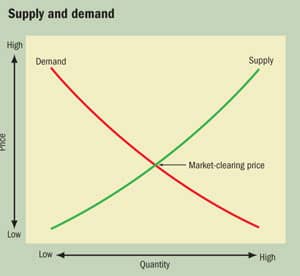
For consultants, coaches, creators, strategists, and experts, this matters because capacity is finite, so even if the demand were infinite, we couldn’t possibly serve everyone.
We aren’t selling another copy of a piece of software. We are selling access to our time, expertise, attention, and intellectual property. At some point, demand starts colliding with capacity, and that’s usually when pricing conversations become interesting.
So how do you know whether it’s time to announce a price increase?
1. Demand consistently exceeds your capacity
This is the most important criterion because it tells you whether the market wants more than you’re currently able to provide.
Most people look for demand in the wrong places. They pay attention to likes, comments, DMs, newsletter replies, podcast compliments, and people telling them they should charge more. None of those things necessarily translates into demand.
Demand shows up in behaviour:
- You’re booked out six to eight weeks in advance.
- You have a waiting list.
- You regularly turn away qualified prospects you’d happily work with.
- Referrals continue arriving without active promotion.
- Existing clients keep renewing.
- Sales continue happening during periods when you’re marketing less aggressively.
Through signals like these, the market is telling you that more people want access to your offer than your current pricing is designed to accommodate.
Price increases should be a consequence of growth that has already happened, NOT a way to spark growth.
2. Your conversion rate is suspiciously high
Who doesn’t love a high conversion rate? Closing 80% or 90% of sales conversations feels fantastic.
The problem is that a very high conversion rate can mean two very different things.
- You might be exceptionally good at sales.
- You might also be creating so little pricing friction that almost nobody hesitates before buying.
If ten qualified prospects get on a call and nine immediately say yes, that’s useful information → the market is telling you that your pricing isn’t creating much resistance.
A better benchmark for increased profitability is: if over 70% of your prospects say “yes”, it’s time to up your prices.
This doesn’t mean you should double your prices overnight. It does mean you should experiment, though.
Pricing strategist Rafi Mohammed has a very interesting take: rather than treating pricing as a fixed number, he encourages businesses to understand how demand responds to different price points. Also, he suggests that demand comes in waves.
I call this business seasonality: there are seasons when a certain offer sells better (for instance, info products and personal coaching sell better at the beginning of the year, when people make resolutions about their transformation).
Consider your own business seasonality before raising your prices: did you get more clients recently because you’re in a good season, or did demand really increase?
One tell-tale sign that the latter is true is:
3. The quality of buyers keeps improving
Sometimes revenue doesn’t change dramatically. Even lead volume can be relatively stable.
Yet something else changes: the people entering your world become better.
(Obviously, I’m not talking about human quality in general but about a better fit for your business.)
You start attracting larger companies, more sophisticated buyers, stronger referrals, and clients who take action instead of collecting information. Both sales and implementation conversations become easier because prospects already understand the problem you’re solving and already trust your expertise.
At that point, pricing can start lagging behind positioning.
Buyers frequently use price as a signal when evaluating quality and very low prices may imply low quality.
This is why I talk about context so often: if all your competitors price similar offers around, say, $1,000, and your price is half that, people will assume what you offer is lower quality.
4. The opportunity cost is becoming painful
This is one of the most overlooked reasons to raise prices. Imagine you’re charging $1,000 for something that takes five hours to deliver.
When you first start out, that may be perfectly reasonable.
A few years later, things might look different.
- Corporate workshops appear.
- Speaking opportunities appear.
- Higher-end consulting projects appear.
- Partnerships appear.
- New revenue streams emerge.
Suddenly, every hour spent on that original offer comes at the expense of something else, so the conversation is no longer about whether the offer is profitable but about whether it remains the best use of your time.
So you can raise your prices OR you can consider retiring an old offer to focus on something else.
5. The product itself became better
If you’ve been selling the same thing for more than a year, odds are it’s better than it was in the beginning. This goes for everything: services, updated courses, memberships, cohort-based programs, and so on.
You probably also have more social proof by now, so your prospects should feel more comfortable spending more money.
Again, this is entirely dependent on context. Remember that value is very subjective, so make sure you can anchor it to some verifiable facts and assets.
I went through a similar process when I decided to raise the prices for The Council
If you’ve been around for a while, you may remember that The Council started as an experiment.
I wanted to create a room for smart solopreneurs, consultants, coaches, creators, and experts who were tired of algorithm drama, AI slop, and surface-level business advice. I wasn’t entirely sure how many people wanted that kind of environment.
So I rewarded the first members who took a chance on something that was more of an idea than a fully developed product with insanely low rates.
Since then, we’ve added workshops, guest experts, resources, discussions, feedback sessions, and a growing body of collective knowledge that simply didn’t exist when I launched it.
More importantly, the people inside continue to impress me:
- The quality of conversations is higher than I expected.
- Members help each other.
- They share what’s working and what’s failing.
- They pressure-test ideas.
- They offer perspectives that I couldn’t possibly provide on my own.
Many members have been telling me from the beginning that I should increase the prices.
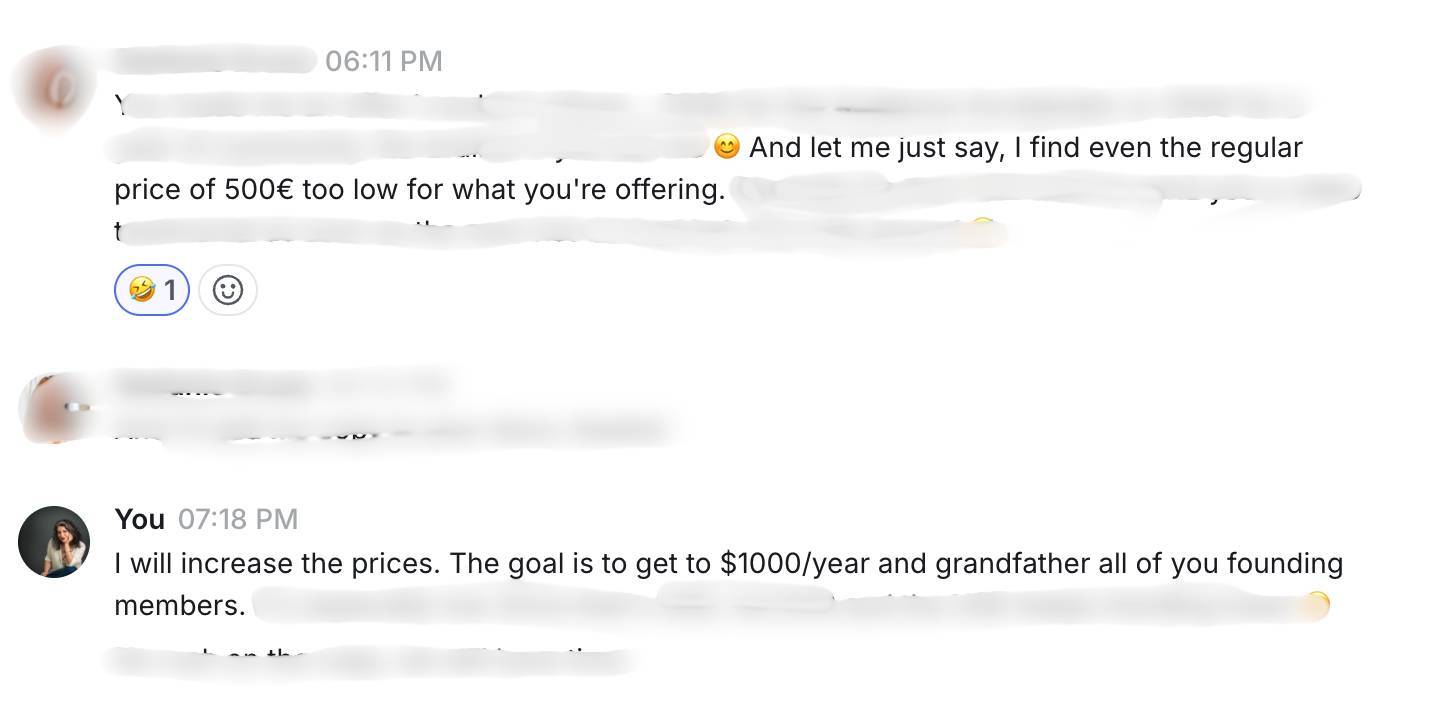
I haven’t until now because I strongly believe higher prices can’t be justified by the fact that you feel that you deserve more. 5 months in, I can run The Council through the framework above and see that:
- Demand is solid → it’s the easiest offer to sell I’ve ever built.
- The conversion rate is around 70% (based on 1:1 conversations)
- The quality of buyers criterion doesn’t apply here because I’ve carefully selected members since the beginning.
- More opportunities that I couldn’t even touch two years ago are coming my way.
- And HECK, YES, the product is much better.
Here’s everything I said in the words of current members (I’ve got more than a dozen testimonials and comments like this).
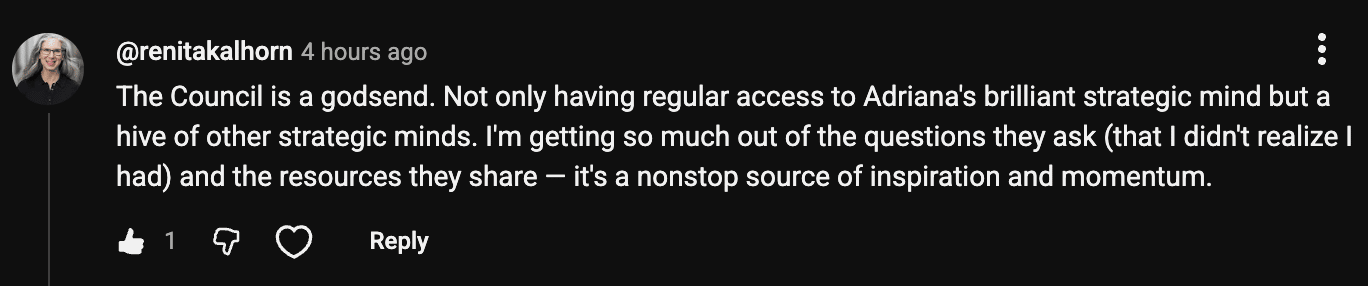
If you’ve been on the fence about joining us, this is the perfect time to do so. Email me if you need more details, or join us here.
🔦 Community Spotlight
Does your online activity put you at risk? I’m asking because solopreneur advice obsesses over getting found. Almost none of it covers what happens once you are.
My friend Susan at Unpublic built the Creator Risk Profile to test the story most of us quietly tell ourselves – “I’m fine, I’m small, nobody’s looking” – against what’s actually true. You get a personalized read on how exposed all that visibility leaves you, scored on the same dimensions she uses in professional investigations, because it’s worth knowing for sure. Free, takes about five minutes.
Get your profile here, because “I’m too small to be a target” isn’t a security strategy.
The Council is hands-down the best thing I’ve ever built. The person who helped me with it the most is my friend Jay Clouse. So, if you’re thinking about building a membership or community of your own, RUN, don’t walk to Jay’s free 3-day live summit on building memberships. Grab your free access here.