
Remember that fantasy that has been circulating in plagued solo businesses for years — “stop trading time for money; escape services. CLICK HERE to learn how to build passive income!!”
I mean, it’s the dream, right? Spend a few hours recording a course, then escape to a remote beach and watch your Stripe notifications come in while you’re sipping Mai Tais.
While this approach looks great on Instagram, it collapses under basic math and upon contact with reality.
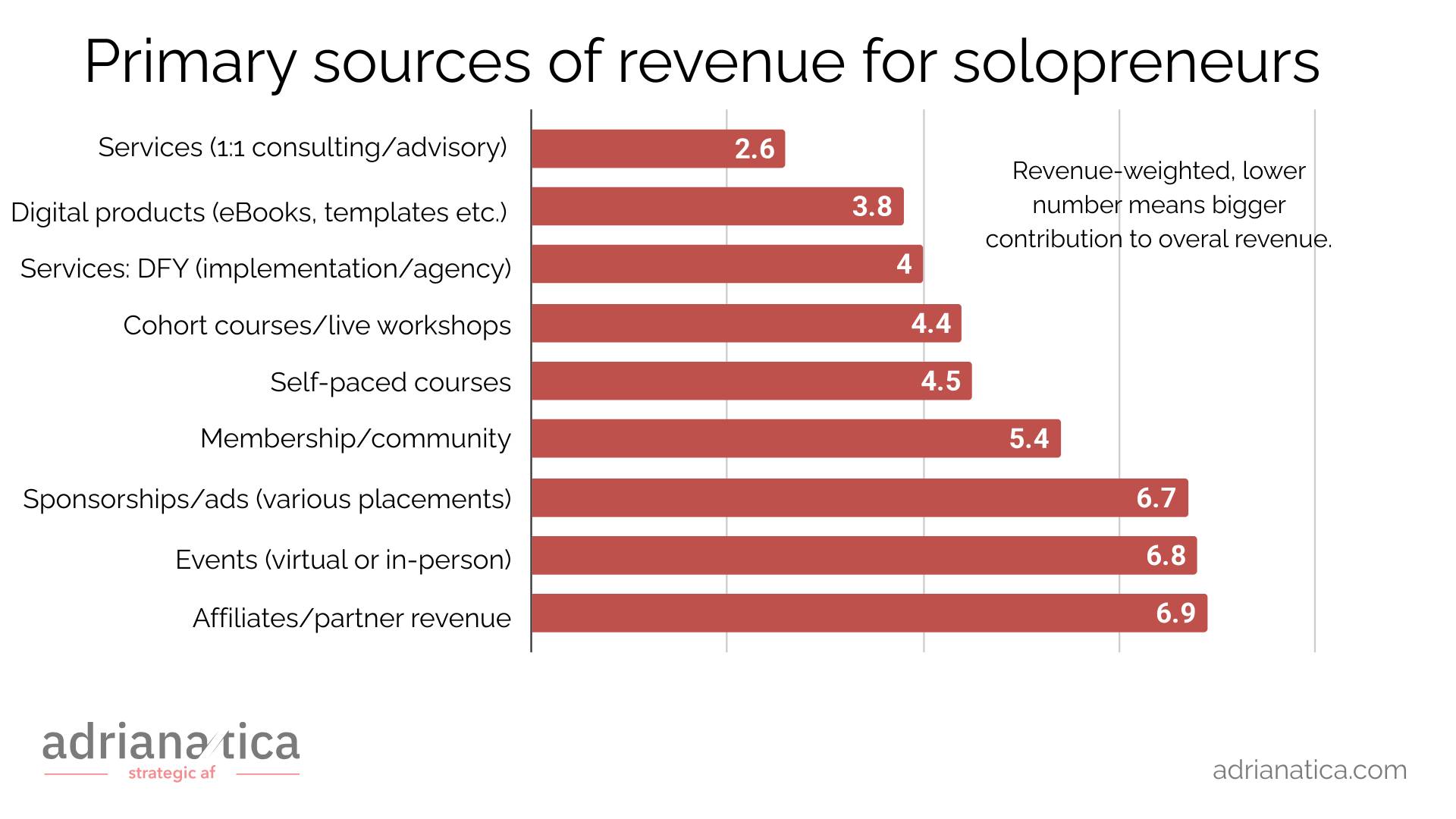
The State of Solopreneurship report showed that the solopreneurs with the most stable income aren’t the ones who “escaped” services but the ones who architected them properly and layered leverage on top.
Kit’s Creator Economy report echoes this finding. Services are more lucrative than digital products.
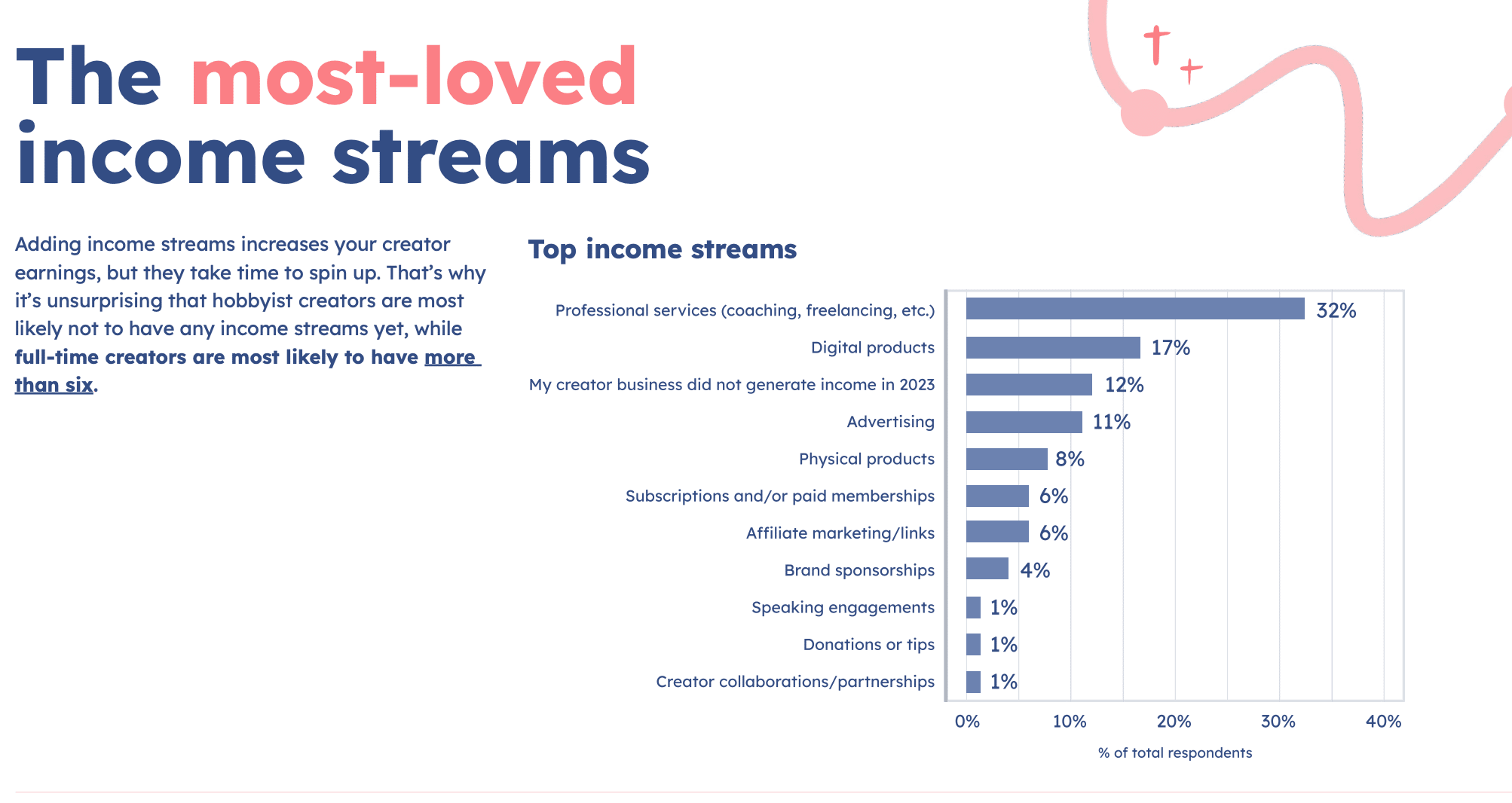
However, stats without context can be very misleading. Common “wisdom” tells you to start with services, then “upgrade” to digital products, and scale endlessly.
Let’s look at it strategically, though, because personally, I’m fed up with de-humanized “ascension funnels”.
This is why I partnered with Maggie Patterson, so I can introduce you to a summit you’re going to love. (Side note: I’m over the moon because I get to promote one of my favorite no-BS people in this space!)
📣 Brought to you by 📣
Profitable & Preferred Summit: The Service Business Summit
Do you want a way to find better clients, close sales more consistently, and stop relying on luck?
Then you need a strategy designed for how clients are buying right now.
And this is exactly what The Profitable & Preferred: The Service Business Summit set out to help you with. It’s a 3-day virtual event featuring 10 experienced service business owners sharing what’s actually working right now to find, sell, and serve clients.
Will I see you there? Whatever Maggie Patterson creates gets an automatic “yes” from me, and I’m super excited for this one!
Want your name up here? Reserve your slot! (Sold out until June)
Think of services as a research lab instead of a stepping stone
Early-stage solopreneurs often treat services as a temporary inconvenience, something to endure until the scalable product “saves” them.
Strategically, that’s backwards.
Services are your highest-signal feedback loop because they reveal:
- The exact objections buyers have.
- The language they use to describe outcomes.
- The real bottlenecks in execution.
- The parts of your framework that actually move revenue.
That signal is more valuable than passive scale.
Course conversion rates vary wildly — often between 0.1% and 10% depending on list quality and warmth. What consistently improves that number is grounding the course in real objections, real language, and real execution friction — all of which are revealed in services.
However big or small your audience is, this kind of increase in conversion rate is hard to ignore.
I’ve seen this firsthand: my courses and info products are all rooted in strategy sessions. I spent a lot of time looking for patterns in what people ask me during these sessions and what their real challenges are.
Everything I’ve built started with a service first or an insight from a service. And they all performed above average — relative to the size of my audience.
Speaking of,
Audience size changes risk tolerance, not just revenue potential
We tend to talk about audience size as a threshold for launches.
- Under 2,000 engaged people, high-ticket depth wins.
- Between 2,000 and 10,000, structured leverage becomes viable (you can start experimenting with products).
- Over 10,000, scalable layers begin to behave predictably.
That framing is correct but incomplete.
Audience size also changes how much experimentation you can afford.
A 1% conversion difference on a 1,500-person list barely registers, while on a 50,000-person list, it can swing six figures.
Larger audiences tolerate more product testing because distribution cushions mistakes. Smaller audiences require precision because every launch consumes relational capital.
Here’s an example: Substack reports that strong writers convert roughly 5–10% of free subscribers into paid tiers.
At 1,000 subscribers, that’s 50–100 paid readers. At 20,000, that’s 1,000–2,000.
You have the same conversion rate but an entirely different margin for error.
I get a lot of pushback when I say that the size of your audience matters, whatever you sell. But the math above proves that, so even if you don’t want to sell digital products, consider this:
You WILL exhaust your audience at some point
This is the part most founders solopreneurs ignore. We all have a number in mind, an audience size that feels comfortable.
However large your audience is, you will eventually reach saturation for a given offer.
This is an important reframe I want you to consider: saturation is not a failure of marketing, but a function of finite attention and finite willingness.
Every market has a carrying capacity at any given moment. No matter how good your marketing is, it will eventually feel like pouring water into a sieve.
Think about it this way: if you have 2,000 engaged people and 3% buy your program, that’s 60 buyers. Those 60 people cannot buy the same program again at full price next quarter.
If you have 10,000 engaged subscribers and 5% convert to paid newsletter tiers, you have tapped a meaningful portion of the willing segment.
Growth plateaus unless distribution expands.
At some point, everyone in your current audience either already bought from you or firmly decided they wouldn’t.
Which means you have two options that are not mutually exclusive but rather work well together.
1. Constantly invest in audience growth
And I do mean constantly. I know most of us do it sporadically, when a launch bombs, or when we feel like we have a couple of days to dedicate to it.
If I learned something more than a decade ago, when I was a freelancer, it’s ABM — Always Be Prospecting. Do it when you don’t need it; don’t wait for the pipeline to dry up — you’ll end up in the famine part of the feast-and-famine cycle.
I always teach my clients that audience growth is a structural responsibility, not a marketing hobby.
2. Design multiple products for the same person.
Most solopreneurs build one flagship offer and treat it like a monument — they sell one thing alone because it’s proven. And yes, that makes sense, especially in the beginning. But, depending on the industry you’re in, the competition, and the ICP you serve, it might be easier to expand your offer stack than to attract enough new buyers month after month.
Your existing audience member has multiple needs over time:
- Skill acquisition.
- Implementation support.
- Strategic recalibration.
- Peer accountability.
- Advanced mastery.
If you only solve one layer of their evolution, your revenue caps early.
Over time, your audience also fixes you in place. They see you as “the LinkedIn person” or “the email person”, or “the strategy person.” Unless you deliberately expand the problem set you solve, you could hit an identity ceiling as much as a revenue one.
A hybrid revenue architecture serves different stages of the same buyer journey. If possible, look beyond a single platform/challenge that you solve.
For instance, I’ve helped my clients with LinkedIn strategy, Threads, email marketing and newsletters, offer architecture, overall strategy, pricing, and more.
This does not mean building ten disconnected products, but solving adjacent problems for the same person.
Retention doesn’t follow an agency model alone. You can (and should!) look at what other struggles your clients have because compounding happens when lifetime value expands.
As a business owner, one of the hardest things to do is anticipate saturation and design workarounds that constrain — ahead of time!
Design your next move with structural awareness
Instead of asking, “What should I build next?” try this:
- What stage is my audience size actually at?
- What percentage of them have already bought my primary offer?
- Have I saturated the obvious segment?
- What adjacent need does my current buyer have that I am not addressing?
- How am I structurally investing in audience growth this quarter?
Then ask a harder question: is my next move expanding distribution, expanding depth, or expanding adjacency?
Write down your answers; then look at your current offers.
If you have under 2,000 engaged people and building low-ticket scale plays, consider whether high-ticket depth would accelerate your trajectory.
If you have over 10,000 engaged people and are still fully dependent on 1:1 services, consider where productization would increase leverage.
If your launches feel weaker each cycle, examine whether audience growth or product adjacency is the bottleneck.
Because it’s usually one of those two — not copywriting, not your product itself, not your social media content. Sure, all of these help, but not enough to mitigate a structural risk.
The Council Bulletin
We’re almost at the end of our Newsletter Growth Bootcamp and I absolutely love how bootcampers’ newsletter strategy has evolved in a mere few weeks.
At the same time, our Decision Clinics (the Q&A-style calls we regularly have within The Council) help people stop overthinking, fix a challenge, and move on with a launch or a partnership.
This week, we addressed product stacks, customer journey mapping, email strategy, and more.
If you’re serious about designing revenue that compounds — and you don’t want to keep rediscovering saturation the hard way — The Council is where we build that architecture deliberately, together. Join us!
🎙️ My podcasts, interviews, and more
My friend Stacy Eleczko and I have two truths and a lie to tell you. We go live on March 12th for a free, laid-back event, where we’ll talk about the (marketing) hills we’re willing to die on. Well, at least a couple of them. Join us!